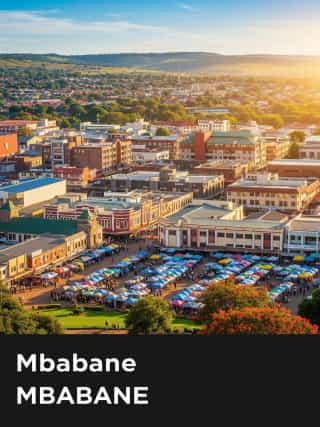
Mbabane - The Capital of Eswatini
- Population
- 94,874
- Language
- English
- Continent
- Africa
- Since
- 1902
- Eco Ranking
- 134/195
Source: Environmental Performance Index 2024.
About Mbabane
Mbabane serves as the administrative and executive capital of Eswatini, a small landlocked kingdom in southern Africa formerly known as Swaziland. The city developed under British colonial administration and became the official seat of government when Swaziland was proclaimed a British protectorate in 1902. Upon independence in 1968, Mbabane retained its administrative role. Eswatini operates a dual-capital arrangement that reflects the country's absolute monarchy: Mbabane is where the cabinet ministries, government offices, and executive functions are located, while Lobamba, approximately 15 kilometers to the southeast, serves as the royal and legislative capital. Lobamba is the seat of the Swazi royal family, the site of the Royal Kraal, and the location where parliament meets. This division is not a colonial accident but an expression of Eswatini's political structure, in which King Mswati III exercises direct absolute authority. Since 1973, political parties have been banned. Eswatini is the last absolute monarchy in Africa. King Mswati III renamed the country from Swaziland to Eswatini in 2018, marking 50 years of independence.
About Eswatini
Eswatini is an absolute monarchy, the last of its kind on the African continent. King Mswati III has ruled since 1986 and governs by decree, with political parties formally banned since 1973. Parliament sits in Lobamba, the royal capital, and operates under a system called Tinkhundla, in which candidates stand as individuals rather than as party representatives. The dual-capital arrangement, administrative functions in Mbabane, royal and legislative functions in Lobamba, is structurally embedded in how the monarchy exercises power. Eswatini is a member of the African Union and SADC.
View Mbabane on the map
Flight time from Mbabane to other capitals
| City | Distance (km) | Flight Time |
|---|---|---|
| Cape Town | 1500 | 1h 46m |
| Abu Dhabi | 6200 | 7h 18m |
| Rome | 7800 | 9h 11m |
| Buenos Aires | 8300 | 9h 46m |
| Singapore | 8400 | 9h 53m |
| Paris | 8800 | 10h 21m |
| London | 9200 | 10h 49m |
| Canberra | 10600 | 12h 28m |
| Washington, D.C. | 13300 | 15h 39m |
| Tokyo | 13300 | 15h 39m |
Capitals with similar population to Mbabane
| City | Population |
|---|---|
| Sri Jayawardenepura Kotte | 115,826 |
| Thimphu | 115,000 |
| Bridgetown | 110,000 |
| Bandar Seri Begawan | 100,700 |
| Mbabane | 94,874 |
| Honiara | 84,520 |
| São Tomé | 80,000 |
Capitals with similar eco ranking to Mbabane
Source: Environmental Performance Index 2024.
Frequently Asked Questions
Why does Eswatini have two capitals?
Eswatini's dual-capital arrangement reflects its political structure as an absolute monarchy. Mbabane serves as the administrative and executive capital, housing government ministries, while Lobamba is the royal and legislative capital, where the Swazi royal family resides, parliament meets, and key royal ceremonies take place. The two cities are about 15 kilometers apart.
When did Mbabane become the capital of Eswatini?
Mbabane became the administrative capital when Swaziland (now Eswatini) was declared a British protectorate in 1902. It retained this role upon independence in 1968. The country was renamed Eswatini in 2018 by King Mswati III.
What is Lobamba's role compared to Mbabane?
Lobamba is the royal and legislative capital of Eswatini. It is the seat of the Swazi royal family, the location of the Royal Kraal (the traditional royal residence), and where the national parliament meets. Mbabane handles executive and administrative government functions. Both cities hold official capital status.
Is Eswatini a democracy?
No. Eswatini is an absolute monarchy under King Mswati III. Political parties have been banned since 1973. Parliament exists but operates under a system where candidates stand as individuals, not as representatives of parties. The king holds supreme authority over all branches of government.
Is Mbabane the largest city in Eswatini?
Mbabane is the administrative capital and one of the two largest cities in Eswatini. Manzini, located in the Manzini Region, is often cited as having a comparable or slightly larger population. However, Mbabane is the seat of government and holds greater political significance.
Sights and landmarks
Climate and best time to visit
Regional significance
Economy