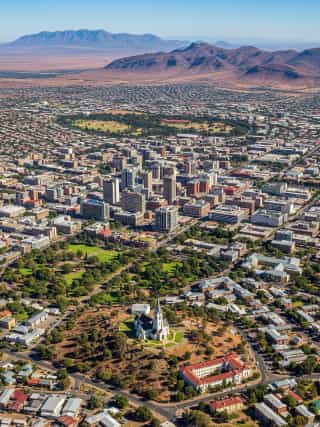
Windhoek - The Capital of Namibia
- Population
- 431,000
- Language
- English
- Continent
- Africa
- Since
- 1990
- Eco Ranking
- 100/195
Source: Environmental Performance Index 2024.
About Windhoek
Windhoek became the administrative center of German South West Africa in 1890, when Germany consolidated its colonial presence in the territory following the 1884 Berlin Conference. The city served German colonial administration through a period that included the systematic extermination of the Herero and Nama peoples between 1904 and 1908, now recognised by Germany as a genocide, and the first genocide of the 20th century. Following Germany's defeat in World War I, South West Africa was placed under South African administration by League of Nations mandate. South Africa administered the territory under apartheid principles, extending its racial classification system to Namibia despite a 1966 UN resolution terminating the mandate. A prolonged independence struggle, led by the South West Africa People's Organisation (SWAPO), culminated in Namibia achieving independence on 21 March 1990, one of the last countries in Africa to decolonize. Windhoek became the capital of the new republic. SWAPO has governed continuously since independence. The legacy of the German colonial genocide remains a live diplomatic issue: Germany formally acknowledged the genocide and offered €1.1 billion in development aid in 2021, but many Herero and Nama leaders rejected the terms as inadequate. Namibia has one of the world's highest levels of income inequality.
About Namibia
Namibia is a presidential republic and one of Africa's more stable democracies, though SWAPO has held power without interruption since independence in 1990. The National Assembly and National Council (parliament) sit in Windhoek, as does the executive. Namibia was the first country in the world to incorporate environmental protection into its constitution. Its economy is based primarily on mining (diamonds, uranium) and cattle farming, but extreme income inequality, a legacy of colonial land distribution, remains a central political issue.
View Windhoek on the map
Flight time from Windhoek to other capitals
| City | Distance (km) | Flight Time |
|---|---|---|
| Cape Town | 1300 | 1h 32m |
| Abu Dhabi | 6600 | 7h 46m |
| Rome | 7200 | 8h 28m |
| Buenos Aires | 7300 | 8h 35m |
| Paris | 8100 | 9h 32m |
| London | 8400 | 9h 53m |
| Singapore | 9700 | 11h 25m |
| Canberra | 11800 | 13h 53m |
| Washington, D.C. | 11900 | 14h 0m |
| Tokyo | 14300 | 16h 49m |
Capitals with similar population to Windhoek
Capitals with similar eco ranking to Windhoek
| City | Eco Rank |
|---|---|
| South Tarawa | 97 |
| Mexico City | 98 |
| Montevideo | 99 |
| Windhoek | 100 |
| Dakar | 101 |
| Cairo | 102 |
| Thimphu | 103 |
Source: Environmental Performance Index 2024.
Frequently Asked Questions
Why is Windhoek the capital of Namibia?
Windhoek became the capital because it served as the administrative center of German South West Africa from 1890 and continued in that role under South African administration. When Namibia gained independence in 1990, Windhoek retained its position as the seat of government.
When did Namibia gain independence?
Namibia gained independence from South Africa on 21 March 1990, following decades of armed struggle led by SWAPO and sustained international pressure including UN resolutions. It was one of the last countries on the African continent to achieve independence.
What was the Herero and Nama genocide?
Between 1904 and 1908, German colonial forces in South West Africa systematically killed an estimated 65,000-80,000 Herero and 10,000 Nama people following uprisings against colonial rule. Survivors were driven into the desert and interned in concentration camps. Germany formally acknowledged this as a genocide in 2021, making it one of the first countries to officially recognise a colonial-era genocide.
How long was Namibia under South African control?
South Africa administered Namibia from 1915, initially under a League of Nations mandate following Germany's defeat in World War I, and then in defiance of UN resolutions after the mandate was terminated in 1966. South African control lasted 75 years in total, until independence in 1990.
Is Windhoek the largest city in Namibia?
Yes, Windhoek is Namibia's largest city, with a population of around 430,000. It is the country's political, economic, and administrative center. Namibia is one of the least densely populated countries in the world, with roughly 2.5 million people spread across a territory larger than France and Germany combined.
Sights and landmarks
Climate and best time to visit
Culture and customs
Economy