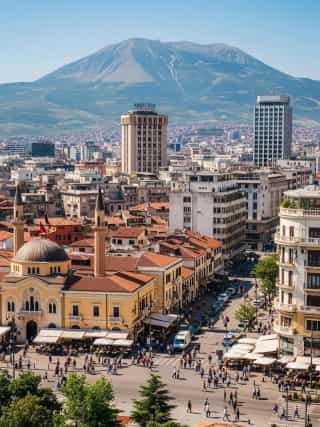
Tirana - The Capital of Albania
- Population
- 418,495
- Language
- Albanian
- Continent
- Europe
- Since
- 1614
- Eco Ranking
- 52/195
Source: Environmental Performance Index 2024.
About Tirana
Tirana was established as a town in the early 17th century and became the capital of an independent Albanian state in 1920, chosen at the Congress of Lushnjë as a compromise location between competing regional factions. Before independence, Albania had been part of the Ottoman Empire for over four centuries, and Tirana's selection as capital reflected the need to balance the interests of the various clans and regions that had formed the new state. Albania's most defining modern experience was the communist regime of Enver Hoxha, who governed from 1944 to his death in 1985. Hoxha's Albania was the most isolated country in Europe during the Cold War, more isolated even than the Soviet bloc states. Hoxha broke with Yugoslavia, the Soviet Union, and eventually China, declaring Albania a self-sufficient atheist state. He banned religion, private property, and foreign travel, and built thousands of concrete bunkers across the country. After Hoxha's death and the collapse of communism in 1991-1992, Albania opened up, but the transition was painful. A collapse of pyramid investment schemes in 1997 triggered a near-civil war, with the government losing control of weapons stockpiles that flooded the region. Albania joined NATO in 2009 and has been an EU candidate country since 2014. Tirana has undergone significant physical transformation since communism's end, with colourful building facades, literally painted in primary colours, becoming a symbol of the post-communist renewal.
About Albania
Albania is a parliamentary republic. The Prime Minister holds executive authority, and the President serves as head of state with limited powers. Albania joined NATO in 2009 and is an EU candidate, with accession negotiations ongoing. The country has transformed significantly since communist isolation ended in 1992, though it continues to grapple with governance challenges including corruption. Albania hosted a significant number of Afghan refugees following the 2021 U.S. withdrawal from Afghanistan.
View Tirana on the map
Flight time from Tirana to other capitals
| City | Distance (km) | Flight Time |
|---|---|---|
| Rome | 600 | 0h 42m |
| Paris | 1600 | 1h 53m |
| London | 1900 | 2h 14m |
| Abu Dhabi | 3700 | 4h 21m |
| Washington, D.C. | 7800 | 9h 11m |
| Cape Town | 8400 | 9h 53m |
| Singapore | 9400 | 11h 4m |
| Tokyo | 9500 | 11h 11m |
| Buenos Aires | 11600 | 13h 39m |
| Canberra | 15600 | 18h 21m |
Capitals with similar population to Tirana
Capitals with similar eco ranking to Tirana
Source: Environmental Performance Index 2024.
Frequently Asked Questions
When did Tirana become the capital of Albania?
Tirana was selected as the capital of Albania at the Congress of Lushnjë in February 1920. It became the capital of independent Albania, which had first declared independence in 1912. The choice of Tirana was a compromise to balance competing regional interests within the young Albanian state.
What was Enver Hoxha's regime like in Albania?
Enver Hoxha governed Albania from 1944 until his death in 1985, establishing one of the most repressive and isolated communist regimes in the world. He broke with Yugoslavia, the Soviet Union, and China sequentially, leaving Albania entirely without allies. He banned religion, private property, and foreign travel, declared Albania the world's first atheist state, and built approximately 170,000 concrete bunkers across the country.
What happened in Albania in 1997?
In 1997, the collapse of fraudulent pyramid investment schemes, in which a significant portion of the Albanian population had invested, triggered a nationwide crisis. Widespread rioting and looting followed, including raids on military arsenals. The government lost control of much of the country, and an international military force led by Italy was deployed to restore order. The crisis resulted in approximately 2,000 deaths.
Is Albania a member of NATO?
Yes. Albania joined NATO on 1 April 2009, along with Croatia. The accession was a major strategic goal for post-communist Albania and marked its integration into Western security structures. NATO membership also required Albania to meet democratic governance and military reform benchmarks.
Is Tirana the largest city in Albania?
Yes. Tirana is the largest city in Albania, with a population of approximately 418,000 in the city proper and over 800,000 in the broader metropolitan area. It houses all central government functions, most economic activity, and the largest share of the country's population. Albania's total population is approximately 2.8 million.
Sights and landmarks
Climate and best time to visit
Culture and customs
Economy