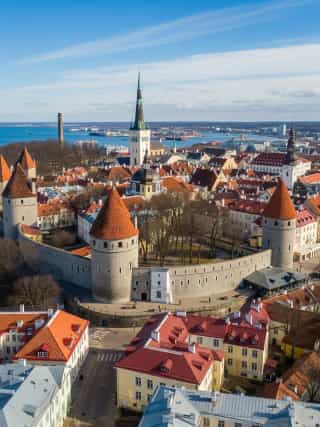
Tallinn - The Capital of Estonia
- Population
- 437,619
- Language
- Estonian
- Continent
- Europe
- Since
- 1991
- Eco Ranking
- 1/195
Source: Environmental Performance Index 2024.
About Tallinn
Tallinn has served as the administrative centre of Estonia since the medieval period, when it was known as Reval and functioned as a key trading city of the Hanseatic League. The city passed through Danish, German, Swedish, and finally Russian imperial control before Estonia declared independence in 1918. Tallinn became the capital of the new republic and remained so until Soviet occupation in 1940. Estonia was forcibly incorporated into the Soviet Union after the Molotov-Ribbentrop Pact assigned it to the Soviet sphere. Soviet occupation was interrupted by German occupation from 1941 to 1944, after which Soviet rule resumed and continued until 1991. Estonia declared the restoration of its independence in 1990, using the language of restoration deliberately, asserting that the Soviet period was illegal occupation rather than legitimate statehood. The Soviet Union formally recognised Estonian independence in September 1991. Estonia joined NATO and the European Union in 2004, and in 2011 adopted the euro. Tallinn's medieval Old Town, one of the best-preserved in Northern Europe, is a UNESCO World Heritage Site. Estonia has become known for its advanced digital governance, it was the first country to hold national elections online, in 2005, and has developed one of the world's most comprehensive digital government systems. Tallinn houses the parliament (Riigikogu), the presidency, and the Supreme Court.
About Estonia
Estonia is a parliamentary republic with a president as head of state and a prime minister leading the government. It is a member of the EU, NATO, and the Eurozone. Estonia maintains a strong position on border security and defence spending, particularly given Russia's proximity and its history of Soviet occupation. The country has the highest number of startups per capita in Europe and is home to the founders of Skype and TransferWise (now Wise).
View Tallinn on the map
Flight time from Tallinn to other capitals
| City | Distance (km) | Flight Time |
|---|---|---|
| London | 1800 | 2h 7m |
| Paris | 1900 | 2h 14m |
| Rome | 2100 | 2h 28m |
| Abu Dhabi | 4500 | 5h 18m |
| Washington, D.C. | 7000 | 8h 14m |
| Tokyo | 7900 | 9h 18m |
| Singapore | 9300 | 10h 56m |
| Cape Town | 10400 | 12h 14m |
| Buenos Aires | 12900 | 15h 11m |
| Canberra | 15200 | 17h 53m |
Capitals with similar population to Tallinn
Capitals with similar eco ranking to Tallinn
Source: Environmental Performance Index 2024.
Frequently Asked Questions
When did Tallinn become the capital of Estonia?
Tallinn became the capital of the independent Republic of Estonia in 1918, following the end of World War I and the collapse of the Russian Empire. The city had been the main administrative centre of the region under various rulers for centuries. After Soviet occupation from 1940, it resumed its role as capital upon Estonia restoring independence in 1991.
How long was Estonia under Soviet occupation?
Estonia was under Soviet occupation from 1940 to 1941, then under German occupation until 1944, then under Soviet control again until 1991, a total of approximately 47 years of Soviet rule. Estonia, Latvia, and Lithuania were the only former Soviet republics that asserted their Soviet incorporation was illegal, framing independence in 1991 as a restoration rather than a new state.
Why is Tallinn's Old Town a UNESCO World Heritage Site?
Tallinn's Old Town was inscribed as a UNESCO World Heritage Site in 1997 for its exceptional preservation of a medieval Northern European trading city. The walled city retains its 13th-15th century layout, towers, and architecture largely intact, making it one of the best-preserved examples of a Hanseatic League settlement. It served as a major trading hub connecting Russia and Western Europe.
Was Estonia the first country to vote online?
Yes. Estonia held the world's first legally binding national election with online voting in 2005, during local elections. Online voting has since been used in all subsequent national and European elections. Estonia has built one of the world's most extensive e-government systems, including digital identity, online tax filing, and digital healthcare records.
When did Estonia join NATO and the EU?
Estonia joined both NATO and the European Union on 1 May 2004. NATO membership was a central strategic priority following independence, given Estonia's history of Soviet occupation and its border with Russia. Estonia also joined the Eurozone in 2011, becoming one of the first former Soviet republics to adopt the euro.
Sights and landmarks
Climate and best time to visit
Regional significance
Economy