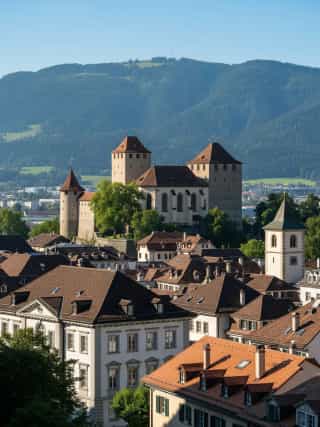
Vaduz - The Capital of Liechtenstein
- Population
- 5,696
- Language
- German
- Continent
- Europe
- Since
- 1719
- Eco Ranking
- -
Source: Environmental Performance Index 2024.
About Vaduz
Vaduz serves as the capital and seat of government of Liechtenstein, a constitutional monarchy situated in the Rhine valley between Switzerland and Austria. The Principality of Liechtenstein was established in its current form in 1719, when Holy Roman Emperor Charles VI united the lordships of Schellenberg and Vaduz into a single principality for the Liechtenstein family. Vaduz became the capital as the seat of the ruling House of Liechtenstein. Liechtenstein holds several notable constitutional and geopolitical distinctions. It is one of only two doubly landlocked countries in the world, surrounded entirely by Switzerland and Austria, both of which are themselves landlocked, the other being Uzbekistan. The reigning Prince holds significant executive authority under Liechtenstein's constitution, including the power to veto legislation, dissolve parliament, and appoint judges. Prince Hans-Adam II extended these powers significantly through a 2003 constitutional revision approved by referendum. Liechtenstein uses the Swiss franc as its currency, is part of the Schengen Area, and forms a customs and monetary union with Switzerland despite not being an EU member. With a population of under 40,000, it is one of the world's smallest states, yet has one of the highest GDP per capita figures in the world, driven by a financial services sector and specialised manufacturing. Vaduz itself has a population of under 6,000.
About Liechtenstein
Liechtenstein is a constitutional monarchy in which the Prince retains substantial executive power, distinguishing it from most European constitutional monarchies where royal authority is ceremonial. The country has no military and relies on Switzerland for defence. Liechtenstein is a member of the European Economic Area (EEA) and the Schengen Area. Its financial sector and low-tax regime have historically attracted significant international business activity, drawing scrutiny over banking secrecy.
View Vaduz on the map
Flight time from Vaduz to other capitals
| City | Distance (km) | Flight Time |
|---|---|---|
| Paris | 600 | 0h 42m |
| Rome | 600 | 0h 42m |
| London | 900 | 1h 4m |
| Abu Dhabi | 4700 | 5h 32m |
| Washington, D.C. | 6700 | 7h 53m |
| Cape Town | 9100 | 10h 42m |
| Tokyo | 9600 | 11h 18m |
| Singapore | 10200 | 12h 0m |
| Buenos Aires | 11300 | 13h 18m |
| Canberra | 16400 | 19h 18m |
Capitals with similar population to Vaduz
| City | Population |
|---|---|
| St. George's | 7,500 |
| Palikir | 6,647 |
| Valletta | 6,444 |
| Funafuti | 6,320 |
| Vaduz | 5,696 |
| San Marino | 4,061 |
| Yaren | 1,100 |
Frequently Asked Questions
Why is Liechtenstein called a doubly landlocked country?
Liechtenstein is surrounded entirely by Switzerland and Austria, both of which are themselves landlocked countries. This means Liechtenstein must cross at least two national borders to reach any ocean or sea, making it 'doubly landlocked.' The only other doubly landlocked country is Uzbekistan, which is surrounded by five other landlocked states.
When did Vaduz become the capital of Liechtenstein?
Vaduz became the capital of the Principality of Liechtenstein when the principality was created in 1719 by Holy Roman Emperor Charles VI, who merged the lordships of Vaduz and Schellenberg. The Liechtenstein family took possession of their new principality in 1719, and Vaduz has served as the seat of government since then.
What powers does the Prince of Liechtenstein hold?
The Prince of Liechtenstein holds substantial constitutional power, including the right to veto any legislation passed by parliament, dissolve parliament, appoint judges, and call referendums. These powers were formalised and extended by a constitutional revision in 2003, approved by referendum. Prince Hans-Adam II and his son Prince Alois, who acts as regent, exercise these powers actively, unlike most European constitutional monarchs.
Is Liechtenstein a member of the European Union?
No. Liechtenstein is not a member of the EU, but it is a member of the European Economic Area (EEA), which gives it access to the EU's single market while allowing it to set its own policies in other areas. It is also part of the Schengen Area, allowing passport-free movement. Liechtenstein uses the Swiss franc and has a customs union with Switzerland.
Is Vaduz the largest city in Liechtenstein?
No. Despite being the capital, Vaduz is not the largest municipality in Liechtenstein, Schaan has a slightly larger population. Vaduz has approximately 5,700 residents. Liechtenstein's total population is under 40,000. The country's small size means that Vaduz's capital functions coexist with what is essentially a small town.
Sights and landmarks
Climate and best time to visit
Regional significance
Economy