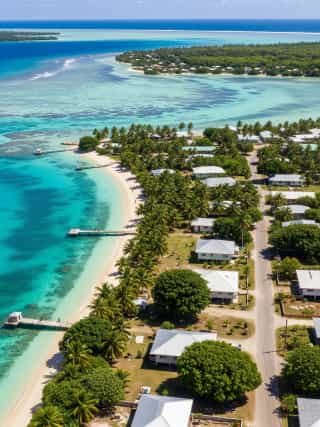
Funafuti - The Capital of Tuvalu
- Population
- 6,320
- Language
- Tuvaluan
- Continent
- Oceania
- Since
- 1978
- Eco Ranking
- -
Source: Environmental Performance Index 2024.
About Funafuti
Funafuti is the capital of Tuvalu, a Pacific island nation of nine atolls spread across 700,000 square kilometers of ocean. The atoll on which Funafuti sits has a mean elevation of less than 2 meters above sea level, making it among the most physically vulnerable capitals on earth to sea-level rise. Tuvalu was a British colony (part of the Gilbert and Ellice Islands) until independence in 1978, when Funafuti became the capital of the new state. The country has a total land area of just 26 square kilometers. During World War II, Funafuti was a significant Allied base in the Pacific theater, and the airstrip built by the U.S. military remains the island's main runway. In 2023, Tuvalu signed a treaty with Australia, the Falepili Union, granting Tuvaluans a pathway to migrate to Australia as climate change makes the islands increasingly uninhabitable, in exchange for Australia having a say in Tuvalu's security arrangements. This was the first formal treaty in the world to offer climate refugee status. Funafuti hosts the parliament (the Fale i Fono), the government ministries, and the only international airport in the country. The future physical existence of Funafuti as a habitable capital is considered one of the most direct consequences of global climate change.
About Tuvalu
Tuvalu is a parliamentary constitutional monarchy within the Commonwealth, with the British monarch as head of state. The unicameral parliament (Fale i Fono) has 16 members. Tuvalu is one of the world's smallest and least-visited countries. Its primary source of revenue is licensing fees from its .tv internet domain name, remittances, and foreign aid. The 2023 Falepili Union with Australia provides for migration rights and Australian involvement in Tuvalu's security and foreign policy, an unprecedented arrangement reflecting the existential threat posed by sea-level rise.
View Funafuti on the map
Flight time from Funafuti to other capitals
| City | Distance (km) | Flight Time |
|---|---|---|
| Canberra | 4300 | 5h 4m |
| Tokyo | 6400 | 7h 32m |
| Singapore | 8400 | 9h 53m |
| Washington, D.C. | 11800 | 13h 53m |
| Buenos Aires | 12300 | 14h 28m |
| Abu Dhabi | 13900 | 16h 21m |
| Cape Town | 14900 | 17h 32m |
| London | 15200 | 17h 53m |
| Paris | 15500 | 18h 14m |
| Rome | 16100 | 18h 56m |
Capitals with similar population to Funafuti
| City | Population |
|---|---|
| St. George's | 7,500 |
| Palikir | 6,647 |
| Valletta | 6,444 |
| Funafuti | 6,320 |
| Vaduz | 5,696 |
| San Marino | 4,061 |
| Yaren | 1,100 |
Frequently Asked Questions
Why is Funafuti considered one of the world's most climate-vulnerable capitals?
Funafuti sits on a coral atoll with a mean elevation of less than 2 meters above sea level. Projections of sea-level rise from climate change, combined with increased frequency of storm surges and saltwater intrusion into freshwater supplies, threaten the physical habitability of the atoll within decades. Tuvalu's capital is frequently cited as one of the territories most immediately threatened by climate change.
What is the Falepili Union between Tuvalu and Australia?
The Falepili Union, signed in November 2023, is a bilateral treaty between Tuvalu and Australia that grants Tuvaluans the right to migrate to Australia for work, education, and residence as climate pressures grow. In return, Australia gains a role in approving Tuvalu's security and foreign policy arrangements with other countries. It is the first formal climate migration treaty of its kind.
When did Funafuti become the capital of an independent Tuvalu?
Funafuti became the capital of independent Tuvalu on 1 October 1978, when Tuvalu gained independence from Britain. Tuvalu had separated from the Gilbert Islands (now Kiribati) in 1975 before becoming fully independent.
How large is Funafuti?
Funafuti atoll has a total land area of approximately 2.4 square kilometers, spread across a reef enclosing a lagoon of about 275 square kilometers. The main islet, Fongafale, holds the bulk of the capital's population of approximately 6,300 residents, more than half of Tuvalu's total population.
How does Tuvalu fund its government?
Tuvalu's primary revenue sources are licensing fees from its .tv internet country code domain (which is commercially valuable to television companies), remittances from Tuvaluans working abroad, fishing license fees, and foreign aid, primarily from Australia, New Zealand, and Japan. Tuvalu has very limited domestic economic resources.
Sights and landmarks
Climate and best time to visit
Regional significance
Economy