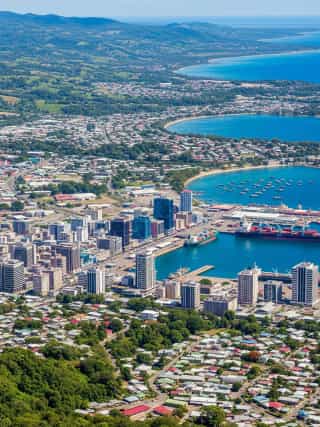
Port Moresby - The Capital of Papua New Guinea
- Population
- 383,000
- Language
- English
- Continent
- Oceania
- Since
- 1975
- Eco Ranking
- 144/195
Source: Environmental Performance Index 2024.
About Port Moresby
Port Moresby became the capital of Papua New Guinea upon independence from Australia in September 1975. The city had served as the British colonial administrative center since the late 19th century, Britain declared a protectorate over the southeastern part of the island of New Guinea in 1884, partly to preempt German expansion. Australia administered the territory as a League of Nations mandate and later a UN Trust Territory following World War II. During World War II, Port Moresby was a critical Allied base and the target of a failed Japanese offensive, the Kokoda Track campaign is commemorated as a defining episode in Australian military history. Papua New Guinea is notable for its extraordinary linguistic diversity: the country has over 800 distinct languages, more than any other nation in the world, representing a vast diversity of largely pre-literate oral traditions and cultures. Port Moresby is a primate city, concentrating government, banking, and formal economic activity in a country where most of the population lives in rural subsistence conditions. Despite significant natural resource wealth, including gold, copper, LNG, and timber, governance challenges, corruption, and poor infrastructure have limited broad economic development. The city has persistently high rates of urban crime and poverty, shaped in part by rapid and poorly managed internal migration.
About Papua New Guinea
Papua New Guinea is a constitutional monarchy and parliamentary democracy within the Commonwealth, with the British monarch as head of state represented by a Governor-General. The unicameral National Parliament operates under a limited preferential voting system. The country occupies the eastern half of the island of New Guinea and numerous offshore islands, sharing a land border with Indonesia.
View Port Moresby on the map
Flight time from Port Moresby to other capitals
| City | Distance (km) | Flight Time |
|---|---|---|
| Canberra | 2900 | 3h 25m |
| Singapore | 4900 | 5h 46m |
| Tokyo | 5100 | 6h 0m |
| Abu Dhabi | 10700 | 12h 35m |
| Cape Town | 12800 | 15h 4m |
| Rome | 14300 | 16h 49m |
| Buenos Aires | 14400 | 16h 56m |
| London | 14500 | 17h 4m |
| Paris | 14500 | 17h 4m |
| Washington, D.C. | 14500 | 17h 4m |
Capitals with similar population to Port Moresby
Capitals with similar eco ranking to Port Moresby
Source: Environmental Performance Index 2024.
Frequently Asked Questions
When did Papua New Guinea gain independence?
Papua New Guinea gained independence from Australia on September 16, 1975. The country had been under Australian administration, first as a League of Nations mandate and later under a UN Trusteeship, since Australia took control of German New Guinea during World War I.
Why does Papua New Guinea have so many languages?
Papua New Guinea's rugged terrain of mountains, rainforests, and islands created conditions of extreme geographic isolation for thousands of years, allowing hundreds of distinct language groups to develop independently. With over 800 languages, PNG accounts for roughly 10% of the world's languages in a country of fewer than 10 million people.
What was the significance of Port Moresby in World War II?
Port Moresby was a key Allied base in the Pacific Theater and a primary strategic objective of Japanese forces in 1942. Japan's overland advance via the Kokoda Track was halted by Australian forces in one of the war's most grueling jungle campaigns. Preventing the fall of Port Moresby was considered critical to protecting Australia from invasion.
Is Papua New Guinea rich in natural resources?
Yes. Papua New Guinea has substantial deposits of gold, copper, silver, oil, and natural gas, as well as significant timber resources. The PNG LNG project, operated partly by ExxonMobil, is one of the largest LNG developments in the Asia-Pacific. However, resource wealth has not substantially reduced poverty due to governance and infrastructure challenges.
Is Port Moresby the largest city in Papua New Guinea?
Yes, Port Moresby is the largest city in Papua New Guinea, though estimates of its population vary. The city has grown rapidly through rural-to-urban migration and is significantly larger than the country's second city, Lae. It concentrates a disproportionate share of formal economic activity and government functions.
Sights and landmarks
Climate and best time to visit
Culture and customs
Economy