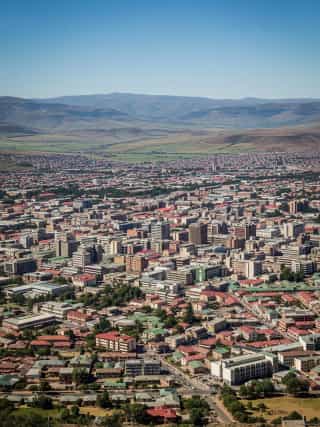
Maseru - The Capital of Lesotho
- Population
- 330,790
- Language
- English
- Continent
- Africa
- Since
- 1966
- Eco Ranking
- 144/195
Source: Environmental Performance Index 2024.
About Maseru
Maseru became the capital of Lesotho upon independence from Britain in 1966, though it had served as the administrative center of the British protectorate of Basutoland since the late 19th century. The city sits along the Caledon River on the western border, directly adjacent to South Africa. As the seat of government for a landlocked kingdom, Maseru houses the parliament, the royal palace, and the principal ministries. Lesotho is a constitutional monarchy; King Letsie III holds the throne while elected governments manage day-to-day administration. The country's political history has been marked by instability, multiple coups and contested elections characterized its post-independence decades, and the army has intervened in civilian politics on several occasions. Maseru was partially ransacked during political unrest in 1998, when South African and Botswanan forces intervened under SADC authorization to restore order. Maseru is the only significant urban center in Lesotho, which remains one of the few countries in the world entirely enclosed within the borders of another, in this case, South Africa.
About Lesotho
Lesotho is a constitutional monarchy within a parliamentary system, with King Letsie III as head of state. It is one of only three countries in the world completely surrounded by another, South Africa encircles it entirely. This geographic fact shapes every aspect of Lesotho's politics, economy, and foreign policy. Lesotho is a member of the Southern African Development Community (SADC) and has relied on regional intervention during periods of political crisis. The country is heavily dependent on remittances from migrant workers employed in South Africa, and its economy is closely tied to its neighbor through the Southern African Customs Union.
View Maseru on the map
Flight time from Maseru to other capitals
| City | Distance (km) | Flight Time |
|---|---|---|
| Cape Town | 1000 | 1h 11m |
| Abu Dhabi | 6600 | 7h 46m |
| Buenos Aires | 7900 | 9h 18m |
| Rome | 8100 | 9h 32m |
| Singapore | 8800 | 10h 21m |
| Paris | 9000 | 10h 35m |
| London | 9400 | 11h 4m |
| Canberra | 10600 | 12h 28m |
| Washington, D.C. | 13200 | 15h 32m |
| Tokyo | 13700 | 16h 7m |
Capitals with similar population to Maseru
| City | Population |
|---|---|
| Yamoussoukro | 355,573 |
| San José | 342,188 |
| Maseru | 330,790 |
| Manama | 330,000 |
| Nicosia | 330,000 |
| Ciudad de la Paz | 297,000 |
| Ljubljana | 295,504 |
Capitals with similar eco ranking to Maseru
| City | Eco Rank |
|---|---|
| Banjul | 143 |
| Accra | 144 |
| Nairobi | 144 |
| Port Moresby | 144 |
| Maseru | 144 |
| Conakry | 145 |
| Port-au-Prince | 146 |
Source: Environmental Performance Index 2024.
Frequently Asked Questions
Why is Maseru the capital of Lesotho?
Maseru was established as the administrative center of the British protectorate of Basutoland in the late 19th century. When Lesotho gained independence in 1966, Maseru retained this role as the national capital. Its location on the western border with South Africa made it a practical center for trade and administration.
When did Maseru become the capital of Lesotho?
Maseru formally became the capital of the independent Kingdom of Lesotho on October 4, 1966, when the country gained independence from Britain. It had previously functioned as the colonial administrative capital of Basutoland since the 1880s.
Is Lesotho completely surrounded by South Africa?
Yes. Lesotho is one of only three countries in the world entirely enclosed within another country, alongside Vatican City and San Marino. South Africa surrounds Lesotho on all sides, making it an enclave state. This has profound implications for Lesotho's foreign policy and economic dependence.
Is Maseru the largest city in Lesotho?
Yes. Maseru is by far the largest city in Lesotho and the only significant urban center in the country. It accounts for the great majority of the country's urban population. No other city approaches it in size or administrative importance.
Has Lesotho experienced political coups?
Yes. Lesotho experienced coups or attempted coups in 1986, 1990, 1991, and 1994. Political instability continued into the 2000s and 2010s, with the military again intervening in 2014. South African-led SADC forces intervened in 1998 to restore order after violent unrest in Maseru.
Sights and landmarks
Climate and best time to visit
Regional significance
Economy