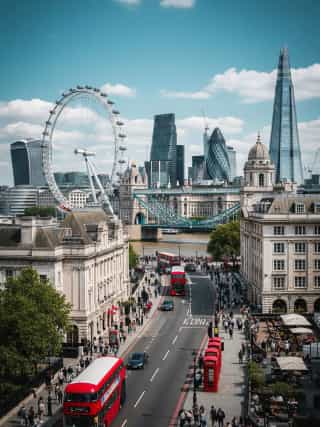
London - The Capital of United Kingdom
- Population
- 9,648,110
- Language
- English
- Continent
- Europe
- Since
- 1066
- Eco Ranking
- 5/195
Source: Environmental Performance Index 2024.
About London
London became the seat of English royal and governmental power following William the Conqueror's victory at the Battle of Hastings in 1066 and his subsequent coronation at Westminster Abbey. Though Roman Londinium had existed for a millennium prior, it was the Norman settlement that cemented the city's political primacy. The Palace of Westminster has housed Parliament since the 13th century, making London one of the longest-serving continuous capitals of any major state. The city served as the administrative center of the British Empire, at its peak the largest empire in world history, directing governance over territories covering roughly a quarter of the earth's land surface. The United Kingdom is a constitutional monarchy and parliamentary democracy: the monarch is head of state, but executive power rests with the prime minister and cabinet, who govern from Downing Street. Parliament consists of the elected House of Commons and the appointed House of Lords. The Supreme Court, established in 2009 to replace the House of Lords' judicial function, sits in Westminster. Greater London's population of 9.6 million exceeds the combined populations of Scotland and Wales. London is the only city to have hosted the modern Olympic Games three times: in 1908, 1948, and 2012.
About United Kingdom
The United Kingdom of Great Britain and Northern Ireland is a constitutional monarchy comprising England, Scotland, Wales, and Northern Ireland. Parliament in Westminster is sovereign, though Scotland, Wales, and Northern Ireland each have devolved legislatures with varying powers. The UK left the European Union on 31 January 2020 following the 2016 Brexit referendum. It is a permanent member of the UN Security Council and a founding member of NATO. The monarch is also head of state of 14 other Commonwealth realms.
View London on the map
Flight time from London to other capitals
| City | Distance (km) | Flight Time |
|---|---|---|
| Paris | 300 | 0h 21m |
| Rome | 1400 | 1h 39m |
| Abu Dhabi | 5500 | 6h 28m |
| Washington, D.C. | 5900 | 6h 56m |
| Tokyo | 9600 | 11h 18m |
| Cape Town | 9700 | 11h 25m |
| Singapore | 10800 | 12h 42m |
| Buenos Aires | 11100 | 13h 4m |
| Canberra | 17000 | 20h 0m |
Capitals with similar population to London
Capitals with similar eco ranking to London
Source: Environmental Performance Index 2024.
Frequently Asked Questions
When did London become the capital of England?
London's status as capital was firmly established following the Norman Conquest of 1066, when William the Conqueror was crowned at Westminster Abbey and established his court there. While London had been the most important city in Anglo-Saxon England, Winchester had shared administrative importance. After 1066, London and Westminster became the uncontested seat of government.
Where does the UK government actually operate from in London?
The UK government operates from several locations in central London. The prime minister and cabinet work from 10 Downing Street in Westminster. Parliament meets in the Palace of Westminster. The monarch's official London residence is Buckingham Palace. The Supreme Court is located in Middlesex Guildhall, also in Westminster. Government departments are spread across Whitehall and surrounding areas.
Is London the largest city in the United Kingdom?
Yes, London is overwhelmingly the largest city in the UK. Greater London has approximately 9.6 million residents, compared to around 1.7 million in Birmingham (the second largest city). London accounts for roughly 14 percent of the UK's total population and generates approximately 25 percent of the country's GDP.
How does devolution affect London's role as capital?
While London houses the UK Parliament, Scotland, Wales, and Northern Ireland each have their own devolved legislatures: the Scottish Parliament in Edinburgh, the Senedd in Cardiff, and the Northern Ireland Assembly in Stormont. These bodies have authority over a range of domestic matters. England alone has no devolved parliament and is governed directly from Westminster.
Was London always the capital of the British Empire?
Yes. London served as the capital of successive English, then British, imperial structures from the 17th century onward. As the British Empire expanded through the 18th and 19th centuries to become the largest empire in world history, London functioned as its political, financial, and communications hub. The Empire's formal dissolution occurred gradually between the late 1940s and the 1990s.
Sights and landmarks
Climate and best time to visit
Economy