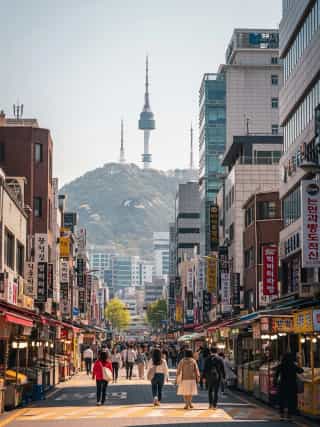
Seoul - The Capital of South Korea
- Population
- 9,720,846
- Language
- Korean
- Continent
- Asia
- Since
- 1394
- Eco Ranking
- 57/195
Source: Environmental Performance Index 2024.
About Seoul
Seoul has served as Korea's capital since 1394, when the founder of the Joseon Dynasty, King Taejo, relocated the seat of government from Kaesong to a new city on the Han River, naming it Hanyang. The city was renamed Keijō under Japanese colonial rule (1910-1945) and returned to Korean control as Seoul following liberation. During the Korean War (1950-1953), Seoul changed hands four times between North Korean, Chinese, South Korean, and United Nations forces, suffering severe destruction. Seoul is located approximately 50 kilometres from the Demilitarized Zone (DMZ) that separates South Korea from North Korea, making it one of the closest capitals in the world to a hostile border. South Korea was one of the world's poorest countries in the early 1960s; it is now the world's 13th largest economy. Seoul houses the National Assembly, the Supreme Court, and the presidential office. The Blue House (Cheong Wa Dae) served as the presidential residence until 2022, when President Yoon Suk-yeol relocated the office to the former Ministry of National Defence building.
About South Korea
South Korea is a presidential republic with a single five-year presidential term and a unicameral National Assembly. The country's rapid industrialisation from the 1960s, the 'Miracle on the Han River', transformed it from one of the world's poorest nations to a major global economy. South Korea maintains a mutual defence treaty with the United States, which stations approximately 28,500 troops on Korean soil.
View Seoul on the map
Flight time from Seoul to other capitals
| City | Distance (km) | Flight Time |
|---|---|---|
| Tokyo | 1200 | 1h 25m |
| Singapore | 4700 | 5h 32m |
| Abu Dhabi | 6900 | 8h 7m |
| Canberra | 8400 | 9h 53m |
| London | 8900 | 10h 28m |
| Paris | 9000 | 10h 35m |
| Rome | 9000 | 10h 35m |
| Washington, D.C. | 11200 | 13h 11m |
| Cape Town | 13700 | 16h 7m |
| Buenos Aires | 19400 | 22h 49m |
Capitals with similar population to Seoul
Capitals with similar eco ranking to Seoul
Source: Environmental Performance Index 2024.
Frequently Asked Questions
How long has Seoul been the capital of Korea?
Seoul has been the capital of Korea since 1394, when King Taejo of the Joseon Dynasty established his court there, making it over 630 years as the principal seat of Korean government. The city has remained the capital through the Joseon Dynasty (1392-1897), the Korean Empire (1897-1910), Japanese colonial rule, and the Republic of Korea since 1948.
How many times did Seoul change hands during the Korean War?
Seoul changed hands four times during the Korean War. North Korean forces captured it in June 1950; UN and South Korean forces retook it in September 1950 during the Incheon Landing; North Korean and Chinese forces captured it again in January 1951; and South Korean and UN forces recaptured it in March 1951. The city suffered severe destruction across multiple sieges.
How close is Seoul to North Korea?
Seoul is approximately 50 kilometres south of the Demilitarized Zone (DMZ) that marks the boundary between South Korea and North Korea. The DMZ follows the armistice line established at the end of the Korean War in 1953. Seoul's proximity to a heavily militarised border makes it one of the most geopolitically exposed capital cities in the world.
Is Seoul the largest city in South Korea?
Yes. Seoul is South Korea's largest city, with approximately 9.7 million residents in the city proper and over 26 million in the greater Seoul Capital Area, which includes Incheon and Gyeonggi Province. The Seoul Capital Area contains about half of South Korea's total population of approximately 52 million.
What was the 'Miracle on the Han River'?
The 'Miracle on the Han River' refers to South Korea's rapid economic development from the early 1960s through the 1990s, during which the country transformed from one of the poorest in the world, with a per capita GDP below that of some African countries in the early 1960s, into a major industrialised economy. The transformation was driven by export-led growth, state-directed investment, and the rise of large industrial conglomerates (chaebols) such as Samsung, Hyundai, and LG.
Sights and landmarks
Climate and best time to visit
Culture and customs
Economy