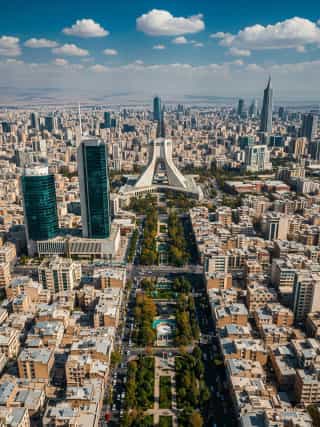
Tehran - The Capital of Iran
- Population
- 9,259,009
- Language
- Persian
- Continent
- Asia
- Since
- 1786
- Eco Ranking
- 114/195
Source: Environmental Performance Index 2024.
About Tehran
Tehran became the capital of Persia in 1786 when Agha Mohammad Khan, founder of the Qajar dynasty, chose it as his seat of power following his consolidation of control over Iran. The city's central location on the northern edge of the Iranian plateau, near the Alborz mountain range, influenced his choice. Under the Qajars and the subsequent Pahlavi dynasty, Tehran expanded into a major metropolis and modernised rapidly in the 20th century. The Iranian Revolution of 1979 transformed the city's political character fundamentally. The monarchy of Mohammad Reza Shah was overthrown, and Ayatollah Khomeini established an Islamic Republic governed by the principle of velayat-e faqih (guardianship of the jurist). Tehran became the seat of a hybrid system: an elected president and parliament coexist with unelected bodies including the Supreme Leader, the Guardian Council, and the Assembly of Experts. The Supreme Leader holds ultimate authority over the armed forces, judiciary, and state media. Tehran houses all major branches of this system. The city has also been the focal point of prolonged international tensions over Iran's nuclear programme, which has led to successive rounds of international sanctions and diplomatic negotiations, including the 2015 JCPOA nuclear agreement and its subsequent collapse. With a population of over 9 million, Tehran is one of the largest cities in the Middle East.
About Iran
Iran is an Islamic Republic governed under the principle of velayat-e faqih, in which supreme authority rests with the Supreme Leader, currently Ali Khamenei, who has held the position since 1989. The elected president and parliament operate within limits set by unelected clerical oversight bodies. Iran is not a member of the Arab League (it is Persian, not Arab) and has a distinct regional foreign policy supporting groups such as Hezbollah in Lebanon and various militias across the Middle East.
View Tehran on the map
Flight time from Tehran to other capitals
| City | Distance (km) | Flight Time |
|---|---|---|
| Abu Dhabi | 1300 | 1h 32m |
| Rome | 3400 | 4h 0m |
| Paris | 4200 | 4h 56m |
| London | 4400 | 5h 11m |
| Singapore | 6600 | 7h 46m |
| Tokyo | 7700 | 9h 4m |
| Cape Town | 8500 | 10h 0m |
| Washington, D.C. | 10200 | 12h 0m |
| Canberra | 12800 | 15h 4m |
| Buenos Aires | 13800 | 16h 14m |
Capitals with similar population to Tehran
Capitals with similar eco ranking to Tehran
| City | Eco Rank |
|---|---|
| Honiara | 111 |
| Ouagadougou | 111 |
| Bissau | 112 |
| Algiers | 114 |
| Tehran | 114 |
| Ciudad de la Paz | 115 |
| Brazzaville | 116 |
Source: Environmental Performance Index 2024.
Frequently Asked Questions
Why is Tehran the capital of Iran?
Tehran became the capital in 1786 when Agha Mohammad Khan, founder of the Qajar dynasty, established his court there. He chose it for its central location and strategic position near the Alborz mountains. It replaced Isfahan as the most important political centre and has remained the capital through the Qajar dynasty, the Pahlavi monarchy, and the Islamic Republic.
What happened in the 1979 Iranian Revolution?
The 1979 revolution overthrew Shah Mohammad Reza Pahlavi and established an Islamic Republic under Ayatollah Ruhollah Khomeini. The revolution was driven by a coalition of Islamist, nationalist, and leftist forces. After the Shah's departure in January 1979, Khomeini returned from exile in February, and a new constitution establishing the principle of clerical governance was approved by referendum.
Who holds power in Tehran's government?
Iran's political system is dual: elected institutions (the president and the Majlis, or parliament) coexist with unelected clerical bodies. The Supreme Leader holds ultimate authority over the armed forces, foreign policy, judiciary, and state media. The Guardian Council vets candidates for all elections, disqualifying many. The Supreme Leader can override decisions of the elected president and parliament.
What is Iran's nuclear programme and why has it caused international tensions?
Iran has pursued uranium enrichment and nuclear development since the 1950s, under both the Shah and the Islamic Republic. Western governments and Israel have long suspected Iran of seeking nuclear weapons capability, which Tehran denies. The programme has led to UN and unilateral sanctions. A multilateral nuclear deal (JCPOA) was reached in 2015 but collapsed after the U.S. withdrew in 2018 under President Trump.
Is Tehran the largest city in Iran?
Yes. Tehran is by far the largest city in Iran, with a population of approximately 9.3 million in the city proper and over 15 million in the greater metropolitan area. It accounts for a disproportionate share of Iran's economic output, government employment, and population. Iran's second-largest city, Mashhad, has a population of around 3.4 million.
Sights and landmarks
Climate and best time to visit
Economy