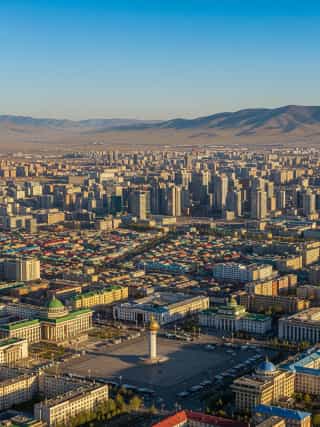
Ulaanbaatar - The Capital of Mongolia
- Population
- 1,584,200
- Language
- Mongolian
- Continent
- Asia
- Since
- 1924
- Eco Ranking
- 142/195
Source: Environmental Performance Index 2024.
About Ulaanbaatar
Ulaanbaatar's origins are unlike those of most national capitals. For much of its history, it was a mobile monastic capital, a large encampment centred on the residence of the Jebtsundamba Khutuktu, the highest Buddhist authority in Mongolia, which relocated across the Mongolian steppe over a dozen times between the 17th and early 20th centuries. It settled at its current location on the Tuul River in 1778. When Mongolia came under Soviet influence in the early 1920s, the city was transformed. The Mongolian People's Republic was proclaimed in 1924, establishing one of the Soviet Union's earliest satellite states. The city was renamed Ulaanbaatar, meaning 'Red Hero', replacing its previous name of Niislel Khüree. The communist period brought rapid industrialisation, Soviet-style urban construction, and the suppression of Buddhism, thousands of monks were killed and monasteries destroyed in the Stalinist purges of the late 1930s. Mongolia transitioned peacefully to democracy in 1990, becoming one of the few countries to make this transition without violence. The first free elections were held in 1990, and a new constitution adopted in 1992. Approximately half of Mongolia's entire population, around 3.5 million people, now lives in Ulaanbaatar, an extraordinary concentration driven by rural-to-urban migration from the traditional nomadic herding economy. The city houses the parliament (Great Khural), the presidency, and the government.
About Mongolia
Mongolia is a parliamentary republic situated between Russia and China, two neighbours that have historically dominated its politics. Mongolia maintains a policy of seeking a 'third neighbour' in diplomatic relations, cultivating ties with the United States, Japan, and the EU as counterweights. Mongolia has significant mineral wealth, including coal and copper, but economic development has been uneven. About 30% of the population still practices nomadic or semi-nomadic herding.
View Ulaanbaatar on the map
Flight time from Ulaanbaatar to other capitals
| City | Distance (km) | Flight Time |
|---|---|---|
| Tokyo | 3000 | 3h 32m |
| Singapore | 5200 | 6h 7m |
| Abu Dhabi | 5300 | 6h 14m |
| London | 7000 | 8h 14m |
| Paris | 7000 | 8h 14m |
| Rome | 7000 | 8h 14m |
| Canberra | 10200 | 12h 0m |
| Washington, D.C. | 10400 | 12h 14m |
| Cape Town | 12600 | 14h 49m |
| Buenos Aires | 18100 | 21h 18m |
Capitals with similar population to Ulaanbaatar
Capitals with similar eco ranking to Ulaanbaatar
Source: Environmental Performance Index 2024.
Frequently Asked Questions
When did Ulaanbaatar become the capital of Mongolia?
Ulaanbaatar in its current location has been the settled capital since 1778, when the nomadic monastic encampment established its permanent site on the Tuul River. It became the capital of the Mongolian People's Republic in 1924, when the Soviet-aligned state was proclaimed and the city was renamed Ulaanbaatar. Before 1778, the mobile capital had relocated over a dozen times.
What does Ulaanbaatar mean?
Ulaanbaatar means 'Red Hero' in Mongolian, reflecting the communist ideology of the Mongolian People's Republic established in 1924. The name replaced Niislel Khüree ('Capital Monastery'). The 'Red' refers to communism, and 'Hero' was a common honorific in Soviet-era naming conventions.
How did Mongolia transition from communism to democracy?
Mongolia transitioned from a Soviet-aligned communist state to a multiparty democracy in 1990. Following mass pro-democracy protests, the ruling Mongolian People's Revolutionary Party agreed to democratic reforms. The first multiparty elections were held in July 1990, and a new democratic constitution was adopted in 1992. Mongolia's transition was notably peaceful compared to transitions in many other communist states.
Why does so much of Mongolia's population live in Ulaanbaatar?
Rapid urbanisation driven by the decline of the nomadic herding economy has concentrated approximately half of Mongolia's total population in Ulaanbaatar. Extreme winters (known as dzud), economic hardship in rural areas, and the concentration of jobs, education, and services in the capital have driven sustained rural-to-urban migration. The city's infrastructure has struggled to keep pace with this growth.
What was Mongolia's relationship with the Soviet Union?
Mongolia was one of the Soviet Union's earliest and closest satellite states. The Mongolian People's Republic was established in 1924 with Soviet backing, and Mongolia was effectively controlled by Moscow for most of its existence. Soviet troops were stationed in Mongolia, and the economy was integrated into the Soviet system. Mongolia was the second country after Russia to adopt Soviet-style communism.
Sights and landmarks
Climate and best time to visit
Regional significance