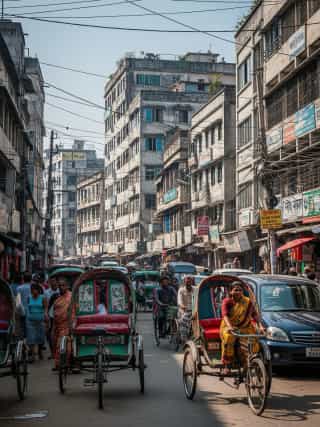
Dhaka - The Capital of Bangladesh
- Population
- 9,540,000
- Language
- Bengali
- Continent
- Asia
- Since
- 1608
- Eco Ranking
- 175/195
Source: Environmental Performance Index 2024.
About Dhaka
Dhaka's political prominence dates to the Mughal period, when it served as the capital of the Bengal Subah (province) from 1608, a role that made it one of the most commercially and administratively significant cities in South Asia. British colonial rule diminished Dhaka's status relative to Calcutta, but the city regained capital status when Bengal was partitioned in 1905, briefly making Dhaka the capital of the new province of Eastern Bengal and Assam. That partition was reversed in 1911. The most consequential partition came in 1947 when British India was divided: Dhaka became the capital of East Pakistan. Political and cultural tensions with West Pakistan, centered on language rights, with the Bengali Language Movement of 1952 being a defining moment, led to the Liberation War of 1971. After a brutal conflict in which Pakistani military forces and allied militias killed hundreds of thousands of civilians, Bangladesh emerged as an independent state with Dhaka as its capital. Today Dhaka is one of the most densely populated cities in the world, housing the parliament (Jatiya Sangsad), the presidency, and the prime minister's office.
About Bangladesh
Bangladesh is a parliamentary republic in which the prime minister holds executive authority. The country experienced military rule and political instability in the decades following independence, alternating between the Awami League and Bangladesh Nationalist Party governments. In 2024, a student-led uprising forced Prime Minister Sheikh Hasina from power after 15 years in office, and an interim government was installed. Bangladesh has achieved significant economic development, particularly in the ready-made garment sector, despite persistent governance challenges.
View Dhaka on the map
Flight time from Dhaka to other capitals
| City | Distance (km) | Flight Time |
|---|---|---|
| Singapore | 2900 | 3h 25m |
| Abu Dhabi | 3600 | 4h 14m |
| Tokyo | 4900 | 5h 46m |
| Rome | 7300 | 8h 35m |
| Paris | 7900 | 9h 18m |
| London | 8000 | 9h 25m |
| Canberra | 9000 | 10h 35m |
| Cape Town | 9900 | 11h 39m |
| Washington, D.C. | 12900 | 15h 11m |
| Buenos Aires | 16800 | 19h 46m |
Capitals with similar population to Dhaka
Capitals with similar eco ranking to Dhaka
Source: Environmental Performance Index 2024.
Frequently Asked Questions
Why is Dhaka the capital of Bangladesh?
Dhaka became the capital of Bangladesh in 1971 following the Liberation War that created the independent state from what had been East Pakistan. The city had been the capital of East Pakistan since 1947 and had long historical significance as an administrative center dating to the Mughal period.
What was the Bengali Language Movement and why did it matter?
The Bengali Language Movement was a political campaign in 1952 in which East Pakistanis, centered in Dhaka, protested the Pakistani government's declaration of Urdu as the sole national language, which threatened Bengali linguistic rights. The movement is considered a foundational event in Bengali national consciousness and a precursor to the 1971 independence movement.
When was Dhaka established as a major administrative capital?
Dhaka first became a major capital in 1608 when it was made the seat of the Mughal Bengal Subah (province) under Islam Khan. It briefly became a provincial capital again under British rule in 1905 when Bengal was partitioned, and then became capital of East Pakistan in 1947.
Is Dhaka the largest city in Bangladesh?
Yes, Dhaka is the largest city in Bangladesh by a wide margin. With approximately 9.5 million residents in the city proper and an estimated 22 million in the greater metropolitan area, it is one of the most densely populated urban areas in the world.
What is the Jatiya Sangsad?
The Jatiya Sangsad is the national parliament of Bangladesh, a unicameral legislature with 350 seats (300 directly elected and 50 reserved for women). It is located in Dhaka in a building designed by American architect Louis Kahn and considered one of the most significant works of 20th-century institutional architecture.
Sights and landmarks
Climate and best time to visit
Regional significance
Economy