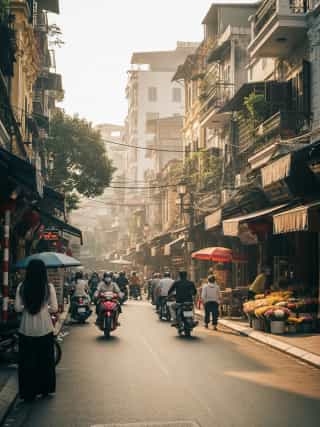
Hanoi - The Capital of Vietnam
- Population
- 8,053,663
- Language
- Vietnamese
- Continent
- Asia
- Since
- 1010
- Eco Ranking
- 180/195
Source: Environmental Performance Index 2024.
About Hanoi
Hanoi has served as the political center of what is now Vietnam for most of the past thousand years, first established as the imperial capital in 1010 by Emperor Lý Thái Tổ, who named it Thăng Long. It was redesignated Hanoi in 1831 under the Nguyen dynasty. French colonial rule, which began in earnest in the 1880s, made Hanoi the capital of French Indochina, leaving a legacy of colonial-era government buildings that still house institutions today. Following the defeat of France at Điện Biên Phủ in 1954 and the division of Vietnam at the 17th parallel, Hanoi became the capital of the Democratic Republic of Vietnam, commonly called North Vietnam, under the leadership of Ho Chi Minh and the Communist Party. Saigon served as the capital of the US-backed Republic of Vietnam in the south. After the fall of Saigon in April 1975 and formal reunification in 1976, the unified Socialist Republic of Vietnam retained Hanoi as its capital. Today, Hanoi is the seat of the National Assembly, the Communist Party of Vietnam's Central Committee, and the presidency. Ho Chi Minh City (formerly Saigon) remains larger and economically more dominant, a persistent structural asymmetry in Vietnamese governance.
About Vietnam
Vietnam is a single-party socialist republic governed by the Communist Party of Vietnam, which holds constitutional authority over all state institutions. The National Assembly, headquartered in Hanoi, formally enacts legislation, but policy is directed by the Party's Politburo. Vietnam was divided from 1954 to 1976 between a communist north and a US-backed south before reunification following the fall of Saigon. The country has pursued market-oriented economic reforms since 1986 under the Doi Moi policy while maintaining one-party rule.
View Hanoi on the map
Flight time from Hanoi to other capitals
| City | Distance (km) | Flight Time |
|---|---|---|
| Singapore | 2200 | 2h 35m |
| Tokyo | 3700 | 4h 21m |
| Abu Dhabi | 5300 | 6h 14m |
| Canberra | 7700 | 9h 4m |
| Rome | 8700 | 10h 14m |
| London | 9200 | 10h 49m |
| Paris | 9200 | 10h 49m |
| Cape Town | 11100 | 13h 4m |
| Washington, D.C. | 13300 | 15h 39m |
| Buenos Aires | 17900 | 21h 4m |
Capitals with similar population to Hanoi
Capitals with similar eco ranking to Hanoi
Source: Environmental Performance Index 2024.
Frequently Asked Questions
Why is Hanoi the capital of Vietnam and not Ho Chi Minh City?
Hanoi has been the political center of the Vietnamese state for most of its modern history. When Vietnam was reunified in 1976 after the fall of Saigon, the Communist Party, which had governed from Hanoi, retained it as the national capital, reflecting northern political dominance in the reunification process.
When did Hanoi first become a capital?
Hanoi was established as an imperial capital in 1010 by Emperor Lý Thái Tổ, who named it Thăng Long. It served as the political center of various Vietnamese dynasties for centuries before French colonization and the modern period.
Was Hanoi the capital during the Vietnam War?
Yes. From 1954 to 1975, Hanoi was the capital of North Vietnam (the Democratic Republic of Vietnam), while Saigon served as the capital of South Vietnam. After reunification in 1976, Hanoi became the capital of the unified Socialist Republic of Vietnam.
Is Hanoi the largest city in Vietnam?
No. Ho Chi Minh City (formerly Saigon) is larger, with a population significantly exceeding Hanoi's. Ho Chi Minh City is also Vietnam's primary economic center, though Hanoi remains the political capital and seat of all central government institutions.
What role did the French play in shaping Hanoi as a capital?
France made Hanoi the capital of French Indochina in the late 19th century, constructing a grid of colonial administrative buildings, many of which still house Vietnamese government offices today. The French colonial footprint significantly shaped the city's built environment and its function as a governmental hub.
Sights and landmarks
Climate and best time to visit
Regional significance
Culture and customs