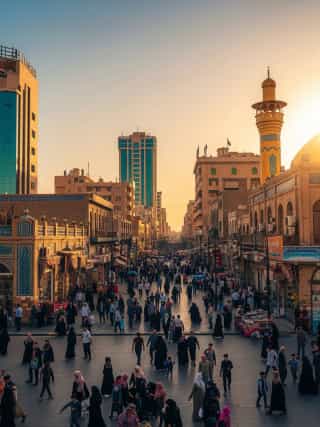
Baghdad - The Capital of Iraq
- Population
- 7,216,040
- Language
- Arabic
- Continent
- Asia
- Since
- 762
- Eco Ranking
- 172/195
Source: Environmental Performance Index 2024.
About Baghdad
Baghdad was founded in 762 CE by Caliph al-Mansur of the Abbasid dynasty as the imperial capital of the Islamic caliphate. Officially named Madinat al-Salam ('City of Peace'), the city was built as a circular planned settlement on the western bank of the Tigris River. Within a century, it had grown into one of the world's largest cities with an estimated population of 1 million, the center of Islamic learning, commerce, and political power during the Islamic Golden Age. The Mongol invasion of 1258 under Hulagu Khan sacked the city, killed the last Abbasid caliph, and destroyed much of its infrastructure, a trauma from which the city took centuries to recover. Baghdad served as a provincial capital under subsequent empires, including the Safavid and Ottoman, and was incorporated into the British Mandate of Mesopotamia following World War I. It became the capital of the Kingdom of Iraq in 1932 at independence, then the republic after the 1958 coup. Saddam Hussein's Ba'athist government ruled from Baghdad from 1968 to 2003, when the US-led invasion toppled the regime. Baghdad remains Iraq's capital, hosting the Council of Representatives, the presidency, and the government, despite ongoing security challenges.
About Iraq
Iraq is a federal parliamentary republic governed under a 2005 constitution drafted after the US-led invasion. The country is organized into 18 governorates plus the autonomous Kurdistan Region. The presidency is largely ceremonial; executive authority rests with the Prime Minister. Iraq's political system allocates top positions across sectarian and ethnic communities (Shia, Sunni, Kurdish) through an informal muhasasa ta'ifia system. The country holds the world's fifth-largest proven oil reserves.
View Baghdad on the map
Flight time from Baghdad to other capitals
| City | Distance (km) | Flight Time |
|---|---|---|
| Abu Dhabi | 1400 | 1h 39m |
| Rome | 2900 | 3h 25m |
| Paris | 3900 | 4h 35m |
| London | 4100 | 4h 49m |
| Singapore | 7100 | 8h 21m |
| Cape Town | 8000 | 9h 25m |
| Tokyo | 8300 | 9h 46m |
| Washington, D.C. | 10000 | 11h 46m |
| Buenos Aires | 13100 | 15h 25m |
| Canberra | 13300 | 15h 39m |
Capitals with similar population to Baghdad
Capitals with similar eco ranking to Baghdad
| City | Eco Rank |
|---|---|
| Manila | 169 |
| Phnom Penh | 170 |
| Kabul | 171 |
| Baghdad | 172 |
| Antananarivo | 173 |
| Asmara | 174 |
| Dhaka | 175 |
Source: Environmental Performance Index 2024.
Frequently Asked Questions
When was Baghdad founded and by whom?
Baghdad was founded in 762 CE by Caliph al-Mansur of the Abbasid dynasty. He chose the site on the Tigris River for its strategic location and agricultural resources. The city was formally named Madinat al-Salam, though it came to be universally known as Baghdad, a name likely derived from a pre-existing Persian settlement.
Why was Baghdad significant during the Islamic Golden Age?
Under Abbasid rule from the 8th to 13th centuries, Baghdad was the center of the Islamic world's intellectual, scientific, and commercial activity. The House of Wisdom (Bayt al-Hikma) was a major translation and research institution that preserved and advanced Greek, Persian, and Indian knowledge. The city's population at its peak may have reached 1 million.
What happened to Baghdad during the Mongol invasion of 1258?
Hulagu Khan's Mongol forces sacked Baghdad in February 1258, killing the Abbasid Caliph Al-Musta'sim and massacring a large portion of the population. Estimates of the dead range from 90,000 to several hundred thousand. The House of Wisdom was destroyed. The invasion ended the Abbasid Caliphate and marked the effective end of the Islamic Golden Age.
When did Baghdad become the capital of modern Iraq?
Baghdad became the capital of the Kingdom of Iraq in 1932, when Iraq gained formal independence from Britain. It had previously been the capital of the British Mandate of Mesopotamia from 1920. After the 1958 revolution that abolished the monarchy, Baghdad became the capital of the Republic of Iraq.
Is Baghdad the largest city in Iraq?
Yes. Baghdad is the largest city in Iraq by a substantial margin, with a population of approximately 7.2 million in the city proper and around 8-9 million in the metropolitan area. The next largest cities, Basra and Mosul, have populations well below 2 million each.
Sights and landmarks
Climate and best time to visit
Regional significance