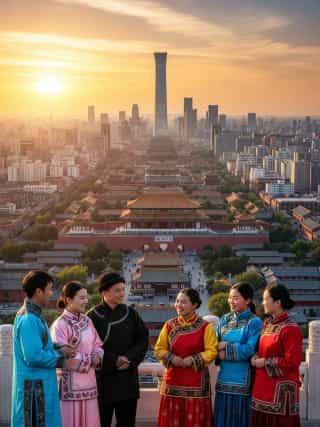
Beijing - The Capital of China
- Population
- 21,540,000
- Language
- Mandarin Chinese
- Continent
- Asia
- Since
- 1421
- Eco Ranking
- 154/195
Source: Environmental Performance Index 2024.
About Beijing
Beijing has functioned as an imperial or national capital for most of the past six centuries. It became the capital of the Ming dynasty in 1421, when the Yongle Emperor relocated the court from Nanjing and constructed the Forbidden City as the imperial seat. The city was known as Peking in Western usage for centuries. In 1928, after the Nationalist government established itself in Nanjing, Beijing was renamed Beiping (meaning 'Northern Peace') and lost its capital status, a period that lasted until 1949, when Mao Zedong proclaimed the People's Republic of China from Tiananmen Gate and restored Beijing as the national capital. Since 1949, the city has been the seat of the Chinese Communist Party's central leadership, housing the State Council, the National People's Congress, and the Central Military Commission. Tiananmen Square, the world's largest urban public square, lies at the city's political center and was the site of the 1989 pro-democracy protests, suppressed by military force with significant loss of life. Beijing hosted the Olympic Games in both 2008 and 2022, the only city to have hosted both the Summer and Winter Games.
About China
China is a one-party state governed by the Chinese Communist Party, with the President also serving as General Secretary of the Party and Chairman of the Central Military Commission, consolidating political, party, and military authority in a single person. The National People's Congress is the nominal legislature but functions largely to ratify Party decisions. Since 2018, presidential term limits have been removed, allowing indefinite tenure.
View Beijing on the map
Flight time from Beijing to other capitals
| City | Distance (km) | Flight Time |
|---|---|---|
| Tokyo | 2100 | 2h 28m |
| Singapore | 4500 | 5h 18m |
| Abu Dhabi | 6000 | 7h 4m |
| London | 8100 | 9h 32m |
| Rome | 8100 | 9h 32m |
| Paris | 8200 | 9h 39m |
| Canberra | 9000 | 10h 35m |
| Washington, D.C. | 11100 | 13h 4m |
| Cape Town | 12900 | 15h 11m |
| Buenos Aires | 19300 | 22h 42m |
Capitals with similar population to Beijing
Capitals with similar eco ranking to Beijing
Source: Environmental Performance Index 2024.
Frequently Asked Questions
When did Beijing become the capital of China?
Beijing first became an imperial capital under the Ming dynasty in 1421, when the Yongle Emperor moved the court from Nanjing. It lost its capital status between 1928 and 1949, when Nanjing served as the Nationalist capital and Beijing was renamed Beiping. It was restored as the national capital in 1949 with the founding of the People's Republic of China.
Why was Beijing renamed Beiping?
When the Nationalist government established its capital in Nanjing in 1928, Beijing was stripped of its capital status and renamed Beiping, meaning 'Northern Peace,' to reflect its reduced political role. The name Beijing, meaning 'Northern Capital,' was restored in 1949 when the Communist Party made it the capital of the new People's Republic.
Is Beijing the largest city in China?
No. By urban population, Shanghai is larger than Beijing. However, Beijing is the political capital and the seat of national government. As of recent estimates, Beijing's municipality holds over 21 million people, but Shanghai's urban agglomeration is generally considered larger.
What happened at Tiananmen Square in 1989?
In April-June 1989, large-scale pro-democracy protests centered on Tiananmen Square in central Beijing. On the night of 3-4 June, the Chinese military was ordered to clear the square, resulting in hundreds to thousands of civilian deaths according to estimates from declassified diplomatic cables. The Chinese government has never released an official death toll and the event remains censored within China.
Has Beijing ever not been China's capital?
Yes. Beijing was not the capital from 1928 to 1949, when the Nationalist government ruled from Nanjing. Before 1421, the Ming capital was also Nanjing. During the Japanese occupation from 1937 to 1945, the city was controlled by Japanese-backed administrations while Chongqing served as the wartime Nationalist capital.
Sights and landmarks
Climate and best time to visit
Culture and customs