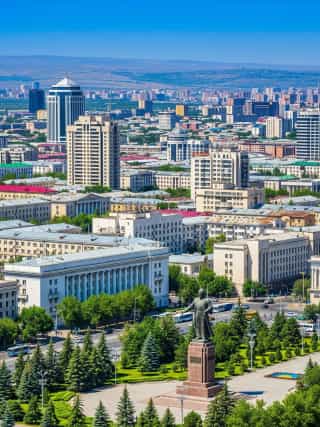
Bishkek - The Capital of Kyrgyzstan
- Population
- 1,074,075
- Language
- Kyrgyz
- Continent
- Asia
- Since
- 1991
- Eco Ranking
- 108/195
Source: Environmental Performance Index 2024.
About Bishkek
Bishkek became the capital of independent Kyrgyzstan in 1991, following the dissolution of the Soviet Union, but the city's role as the region's administrative center dates to the Soviet period. During the Soviet era, it was known as Frunze, named after Mikhail Frunze, the Bolshevik military commander who was instrumental in bringing Central Asia under Soviet control in the early 1920s. The city was renamed Bishkek in 1991, reclaiming a pre-Soviet name. Under Soviet administration, the city was built up as the capital of the Kirghiz Soviet Socialist Republic, and its layout bears the hallmarks of Soviet urban planning, wide boulevards, monumental public buildings, and a central Ala-Too Square that has served as the focal point of Kyrgyzstan's political crises. Kyrgyzstan has experienced three government overthrows since independence: in 2005 (the Tulip Revolution, which removed President Akayev), in 2010 (which removed President Bakiyev and resulted in significant violence in Bishkek), and in 2020 (which removed President Jeenbekov). Bishkek houses the Jogorku Kenesh (parliament), the Presidential Administration, and the government offices.
About Kyrgyzstan
Kyrgyzstan is a presidential republic in Central Asia, bordering China, Kazakhstan, Tajikistan, and Uzbekistan. It has the most competitive political environment among the Central Asian states, though it remains prone to instability, three governments have been removed by popular uprising or coup since 2005. Russia maintains a significant military and economic presence in the country, which is a member of the Russia-led Eurasian Economic Union.
View Bishkek on the map
Flight time from Bishkek to other capitals
| City | Distance (km) | Flight Time |
|---|---|---|
| Abu Dhabi | 2800 | 3h 18m |
| Rome | 5000 | 5h 53m |
| Paris | 5400 | 6h 21m |
| London | 5500 | 6h 28m |
| Tokyo | 5500 | 6h 28m |
| Singapore | 5500 | 6h 28m |
| Cape Town | 10300 | 12h 7m |
| Washington, D.C. | 10500 | 12h 21m |
| Canberra | 11500 | 13h 32m |
| Buenos Aires | 15900 | 18h 42m |
Capitals with similar population to Bishkek
Capitals with similar eco ranking to Bishkek
Source: Environmental Performance Index 2024.
Frequently Asked Questions
What was Bishkek called during the Soviet era?
During the Soviet era, Bishkek was called Frunze, named after Mikhail Frunze, the Bolshevik military leader who commanded Soviet forces in the conquest of Central Asia in the early 1920s. The city was renamed Bishkek in 1991 when Kyrgyzstan declared independence from the Soviet Union.
When did Bishkek become the capital of Kyrgyzstan?
Bishkek became the capital of independent Kyrgyzstan on 31 August 1991, when the country declared independence following the failed coup against Mikhail Gorbachev in Moscow. It had previously functioned as the capital of the Kirghiz Soviet Socialist Republic.
How many times has Kyrgyzstan's government been overthrown?
Kyrgyzstan's government has been overthrown three times since independence: in 2005, when the Tulip Revolution removed President Askar Akayev; in 2010, when President Kurmanbek Bakiyev was forced from power amid violent clashes in Bishkek; and in 2020, when President Sooronbay Jeenbekov resigned following protests over disputed parliamentary elections.
Is Bishkek the largest city in Kyrgyzstan?
Yes. Bishkek is the largest city in Kyrgyzstan, with around 1.07 million residents, roughly a sixth of the country's total population. The second-largest city, Osh, in the south of the country, is significantly smaller at around 300,000 people.
What is the significance of Ala-Too Square in Bishkek?
Ala-Too Square is the central public square of Bishkek, located in front of the State Historical Museum and near key government buildings. It has been the focal point of all three of Kyrgyzstan's political upheavals, the 2005, 2010, and 2020 government collapses all involved mass protests on or near the square, making it the symbolic center of the country's political life.
Sights and landmarks
Climate and best time to visit
Economy