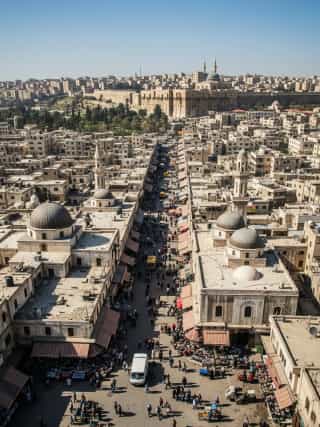
Damascus - The Capital of Syria
- Population
- 2,079,000
- Language
- Arabic
- Continent
- Asia
- Since
- 1946
- Eco Ranking
- -
Source: Environmental Performance Index 2024.
About Damascus
Damascus is among the oldest continuously inhabited cities in the world, with evidence of settlement dating back at least five millennia. It served as the capital of the Umayyad Caliphate from 661 to 750 CE, the first major Islamic empire, during which it was the political center of a state stretching from the Iberian Peninsula to Central Asia. After the Abbasid shift of the caliphate to Baghdad, Damascus remained a regional administrative center under successive empires, Abbasid, Crusader, Ayyubid, Mamluk, and Ottoman. Syria's modern capital status dates to independence from French mandate rule in 1946. The Assad family, Hafez al-Assad from 1970 and his son Bashar from 2000, ruled Syria and governed from Damascus for over five decades. When the Syrian civil war began in 2011, Damascus remained under government control throughout the conflict, even as other major cities fell to opposition forces. The Assad regime fell in December 2024 when opposition forces led by Hayat Tahrir al-Sham took the city, ending more than five decades of Assad rule. Damascus is now the capital of a post-Assad Syria navigating an uncertain political transition.
About Syria
Syria is in a transitional political period following the fall of the Assad government in December 2024. The country had been under Ba'ath Party rule since 1963 and under the Assad family since 1970. The Syrian civil war, which began in 2011, resulted in an estimated 300,000 to 500,000 deaths and displaced over half of Syria's pre-war population. The nature of the new governing authority and Syria's institutional future remains unresolved. Syria is a member of the Arab League, though its membership was suspended from 2011 to 2023.
View Damascus on the map
Flight time from Damascus to other capitals
| City | Distance (km) | Flight Time |
|---|---|---|
| Abu Dhabi | 2000 | 2h 21m |
| Rome | 2300 | 2h 42m |
| Paris | 3300 | 3h 53m |
| London | 3500 | 4h 7m |
| Cape Town | 7700 | 9h 4m |
| Singapore | 7900 | 9h 18m |
| Tokyo | 9000 | 10h 35m |
| Washington, D.C. | 9400 | 11h 4m |
| Buenos Aires | 12400 | 14h 35m |
| Canberra | 14000 | 16h 28m |
Capitals with similar population to Damascus
| City | Population |
|---|---|
| Brazzaville | 2,230,821 |
| Paris | 2,161,000 |
| Phnom Penh | 2,129,371 |
| Havana | 2,106,146 |
| Damascus | 2,079,000 |
| Minsk | 1,982,444 |
| Panama City | 1,938,000 |
Frequently Asked Questions
How old is Damascus?
Damascus is one of the oldest continuously inhabited cities in the world. Archaeological evidence indicates settlement in the area dating back to at least the third millennium BCE, and written records of the city appear in ancient Egyptian and Akkadian texts from around 1500 BCE.
When was Damascus the capital of a major empire?
Damascus served as the capital of the Umayyad Caliphate from 661 to 750 CE. During this period it was the administrative center of the largest empire of its time, stretching from Spain and Morocco in the west to the borders of India and China in the east.
When did the Assad regime fall and what happened to Damascus?
The Assad regime fell in December 2024, when opposition forces led primarily by Hayat Tahrir al-Sham captured Damascus, ending Bashar al-Assad's government. Assad fled the country. Damascus thus became the capital of a post-Assad transitional authority, with significant uncertainty about the political structure going forward.
Was Damascus affected by the Syrian civil war?
Damascus remained under Assad government control throughout most of the civil war that began in 2011, though the city and its suburbs experienced significant fighting, sieges of surrounding areas, and aerial bombardment of opposition-held districts. Several suburbs, including Eastern Ghouta, suffered major destruction and population displacement.
When did Syria gain independence and establish Damascus as its capital?
Syria gained independence from French Mandate rule in 1946, and Damascus was established as the capital of the independent Syrian Republic. France had administered Syria under a League of Nations mandate since 1920, following the collapse of the Ottoman Empire after World War I.
Sights and landmarks
Climate and best time to visit
Regional significance
Economy