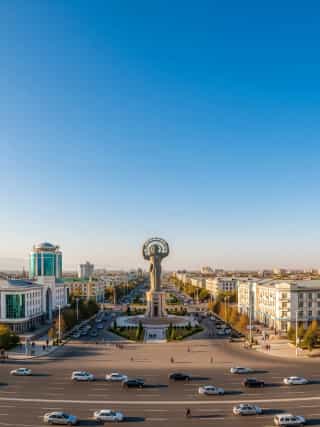
Dushanbe - The Capital of Tajikistan
- Population
- 863,400
- Language
- Tajik
- Continent
- Asia
- Since
- 1991
- Eco Ranking
- 168/195
Source: Environmental Performance Index 2024.
About Dushanbe
Dushanbe's name derives from the Tajik word for Monday, the city developed around a Monday market that was a trading point before Soviet-era urbanization. When the Tajik Autonomous Soviet Socialist Republic was established in 1924 and elevated to a full Soviet republic in 1929, Dushanbe was selected as its capital and rapidly developed from a small market town into an administrative city. It was renamed Stalinabad from 1929 to 1961, reverting to Dushanbe following de-Stalinization under Khrushchev. Tajikistan declared independence in 1991 as the Soviet Union dissolved, and Dushanbe became the capital of a new state. However, independence was followed almost immediately by a civil war (1992-1997) between the post-Soviet government and a coalition of Islamist and democratic opposition forces, one of the bloodiest conflicts in post-Soviet space. Dushanbe was contested and damaged during the war. The government of Emomali Rahmon, who came to power in 1994, has governed since, making him one of the world's longest-serving leaders. Tajikistan shares a border with Afghanistan, and Dushanbe's proximity to that border shapes its security concerns and its relationships with Russia (which maintains a military base there) and China.
About Tajikistan
Tajikistan is an authoritarian presidential republic governed by Emomali Rahmon, who has held power since 1994. Political opposition is suppressed, press freedom is severely restricted, and elections are not considered free or fair by international observers. Tajikistan is the poorest country in the former Soviet space by GDP per capita. Remittances from Tajik workers abroad, primarily in Russia, constitute the largest share of national income. Russia maintains its largest overseas military base, the 201st Military Base, in Dushanbe.
View Dushanbe on the map
Flight time from Dushanbe to other capitals
| City | Distance (km) | Flight Time |
|---|---|---|
| Abu Dhabi | 2100 | 2h 28m |
| Rome | 4700 | 5h 32m |
| Paris | 5300 | 6h 14m |
| London | 5400 | 6h 21m |
| Singapore | 5500 | 6h 28m |
| Tokyo | 6100 | 7h 11m |
| Cape Town | 9600 | 11h 18m |
| Washington, D.C. | 10700 | 12h 35m |
| Canberra | 11600 | 13h 39m |
| Buenos Aires | 15300 | 18h 0m |
Capitals with similar population to Dushanbe
Capitals with similar eco ranking to Dushanbe
| City | Eco Rank |
|---|---|
| Guatemala City | 167 |
| Djibouti | 168 |
| Dushanbe | 168 |
| Manila | 169 |
| Phnom Penh | 170 |
| Kabul | 171 |
| Baghdad | 172 |
Source: Environmental Performance Index 2024.
Frequently Asked Questions
What does the name Dushanbe mean?
Dushanbe means 'Monday' in Tajik. The name derives from the Monday market (dushanbe bozor) that existed at the site before Soviet urbanization transformed the settlement into a capital city. The name was retained, with an interruption as Stalinabad from 1929 to 1961, as the city grew.
When was Dushanbe called Stalinabad?
Dushanbe was renamed Stalinabad in 1929 when the Tajik Soviet Socialist Republic was established, as part of the Stalinist practice of naming cities after Soviet leaders. The original name was restored in 1961 during Nikita Khrushchev's de-Stalinization campaign, which saw many Soviet cities renamed.
What was the Tajik civil war and how did it affect Dushanbe?
The Tajik civil war lasted from 1992 to 1997, fought between the post-Soviet government (backed by Russia and Uzbekistan) and a coalition of Islamist and democratic opposition groups. Dushanbe changed hands during the early phase of the conflict and suffered significant damage. The war killed an estimated 50,000 to 100,000 people and displaced hundreds of thousands.
Is Dushanbe the largest city in Tajikistan?
Yes, Dushanbe is the largest city in Tajikistan, with approximately 863,000 residents. It is the country's primary political, economic, and educational center, and houses the presidential palace, the parliament, and major state institutions.
Why does Russia have a military base in Dushanbe?
Russia's 201st Military Base in Dushanbe is Russia's largest overseas military installation, hosting approximately 7,000 troops. It exists under a bilateral basing agreement, driven by Tajikistan's proximity to Afghanistan, Russian security interests in Central Asia, and Tajikistan's military dependence on Russia following the civil war. The base has been extended multiple times, most recently to 2042.
Sights and landmarks
Climate and best time to visit
Regional significance
Economy