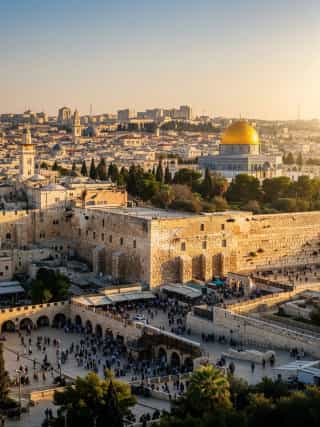
Jerusalem - The Capital of Israel
- Population
- 936,425
- Language
- Hebrew
- Continent
- Asia
- Since
- 1950
- Eco Ranking
- 75/195
Source: Environmental Performance Index 2024.
About Jerusalem
Jerusalem's status as a capital is among the most contested political questions in the world. Israel designates Jerusalem as its capital and has housed its parliament (the Knesset), Supreme Court, and government ministries there since 1950. However, this designation is not recognized by the United Nations or the majority of countries, and most states historically maintained their embassies in Tel Aviv. The dispute centers on East Jerusalem, which Israel occupied during the 1967 Six-Day War and subsequently annexed, an annexation that has not been recognized under international law. East Jerusalem includes the Old City and sites of profound significance to Judaism, Islam, and Christianity. The international legal position, reflected in UN Security Council resolutions, is that the final status of Jerusalem must be determined through negotiation between Israelis and Palestinians, not unilateral action. In 2017, the United States recognized Jerusalem as Israel's capital under President Trump and relocated its embassy there from Tel Aviv in 2018, a move followed by a small number of other countries but rejected by most of the international community. Jerusalem is also claimed by Palestinians as the capital of a future Palestinian state, particularly East Jerusalem. The city remains the administrative seat of the Israeli government regardless of the ongoing international dispute over its status.
About Israel
Israel is a parliamentary democracy in the Middle East, governed by the Knesset, a 120-member unicameral parliament, and a prime minister who holds executive authority. It declared independence in 1948 following the end of the British Mandate for Palestine. Israel has fought multiple wars with neighboring Arab states and continues to govern or occupy Palestinian territories in the West Bank and Gaza Strip. The question of Palestinian statehood and the final status of Jerusalem remain among the most disputed issues in international politics.
View Jerusalem on the map
Flight time from Jerusalem to other capitals
| City | Distance (km) | Flight Time |
|---|---|---|
| Abu Dhabi | 2000 | 2h 21m |
| Rome | 2300 | 2h 42m |
| Paris | 3300 | 3h 53m |
| London | 3600 | 4h 14m |
| Cape Town | 7500 | 8h 49m |
| Singapore | 7900 | 9h 18m |
| Tokyo | 9100 | 10h 42m |
| Washington, D.C. | 9500 | 11h 11m |
| Buenos Aires | 12200 | 14h 21m |
| Canberra | 14000 | 16h 28m |
Capitals with similar population to Jerusalem
Capitals with similar eco ranking to Jerusalem
Source: Environmental Performance Index 2024.
Frequently Asked Questions
Why do most countries not recognize Jerusalem as Israel's capital?
Most countries do not recognize Jerusalem as Israel's capital because of its disputed status under international law. UN Security Council resolutions hold that the final status of Jerusalem, including East Jerusalem, which Israel occupied in 1967 and annexed, must be determined through negotiations between Israelis and Palestinians, not through unilateral declarations.
When did Israel declare Jerusalem its capital?
Israel declared Jerusalem its capital in 1950, two years after declaring independence. The Israeli parliament, the Knesset, moved to Jerusalem in 1950, and the government has operated from the city since that time, though international recognition of this designation remains limited.
Why do many countries keep their embassies in Tel Aviv?
Because most countries do not recognize Israel's claim to Jerusalem as its undivided capital, they historically maintained embassies in Tel Aviv rather than Jerusalem. This position reflects the international consensus that Jerusalem's final status must be resolved through a peace process.
What did the US do regarding Jerusalem in 2017?
In December 2017, President Donald Trump announced US recognition of Jerusalem as Israel's capital, a break from decades of US policy. The US Embassy was relocated from Tel Aviv to Jerusalem in May 2018. The move was condemned by Palestinian leadership and most of the international community, though a small number of countries followed suit.
What is East Jerusalem and why is it significant?
East Jerusalem was under Jordanian control from 1948 to 1967, when Israel captured and subsequently annexed it. It contains the Old City, including the Temple Mount/Haram al-Sharif, the Western Wall, the Church of the Holy Sepulchre, and the Al-Aqsa Mosque, sites central to Judaism, Islam, and Christianity. Palestinians claim East Jerusalem as the capital of a future Palestinian state.
Sights and landmarks
Regional significance
Culture and customs