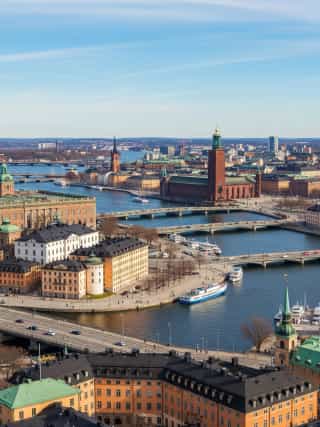
Stockholm - The Capital of Sweden
- Population
- 975,551
- Language
- Swedish
- Continent
- Europe
- Since
- 1523
- Eco Ranking
- 6/195
Source: Environmental Performance Index 2024.
About Stockholm
Stockholm has been the centre of Swedish political power since Gustav Vasa established it as the capital in 1523, consolidating control over a newly independent Sweden after breaking from the Kalmar Union and expelling Danish influence. Built across 14 islands where Lake Mälaren meets the Baltic Sea, the city's geography shaped its strategic value as both a trading hub and a defensible seat of power. Sweden's constitutional framework places all executive authority in the elected government. The monarch holds no executive power, the King performs ceremonial duties, and the prime minister governs. The Riksdag, Sweden's unicameral parliament, sits on Helgeandsholmen in central Stockholm and has been the legislative heart of Swedish democracy since the late 19th century. Sweden's political identity was long defined by its policy of armed neutrality, maintained through two world wars and the Cold War, one of the longest-sustained neutrality policies in modern history. That posture ended in March 2024, when Sweden formally joined NATO, following Finland's accession in 2023. The decision marked the most significant shift in Swedish foreign and defence policy in over 200 years, driven by Russia's full-scale invasion of Ukraine in 2022. Stockholm is also home to the Nobel Prize award ceremonies, held annually in December.
About Sweden
Sweden is a constitutional monarchy with a parliamentary system of government. The Riksdag holds legislative power, and the Prime Minister leads the executive. The monarch's role is purely ceremonial. Sweden was a founding member of the European Union in 1995 and joined NATO in March 2024, ending more than two centuries of military non-alignment. Sweden is one of the world's most developed welfare states, with high public expenditure on social services.
View Stockholm on the map
Flight time from Stockholm to other capitals
| City | Distance (km) | Flight Time |
|---|---|---|
| London | 1400 | 1h 39m |
| Paris | 1500 | 1h 46m |
| Rome | 2000 | 2h 21m |
| Abu Dhabi | 4800 | 5h 39m |
| Washington, D.C. | 6600 | 7h 46m |
| Tokyo | 8200 | 9h 39m |
| Singapore | 9600 | 11h 18m |
| Cape Town | 10400 | 12h 14m |
| Buenos Aires | 12600 | 14h 49m |
| Canberra | 15600 | 18h 21m |
Capitals with similar population to Stockholm
Capitals with similar eco ranking to Stockholm
Source: Environmental Performance Index 2024.
Frequently Asked Questions
Why is Stockholm the capital of Sweden?
Stockholm became Sweden's capital in 1523 when Gustav Vasa made it the seat of his newly independent kingdom after breaking from the Kalmar Union. Its location at the junction of Lake Mälaren and the Baltic Sea made it strategically important for trade and defence. It has remained the capital and seat of government continuously since then.
When did Sweden join NATO?
Sweden formally joined NATO on 7 March 2024, ending over 200 years of military non-alignment. The application was submitted in May 2022, shortly after Russia's full-scale invasion of Ukraine. Sweden's accession required ratification by all existing NATO members, with Hungary and Turkey being the last to approve.
What is the role of the Swedish monarch in Stockholm?
The Swedish monarch holds no executive or legislative power under the 1974 Instrument of Government, which stripped the Crown of all formal political authority. The King performs ceremonial duties, including formally receiving the new government after elections. Executive power rests with the Prime Minister and cabinet.
Where does the Swedish parliament sit?
The Riksdag, Sweden's unicameral parliament, is located on the island of Helgeandsholmen in central Stockholm, directly adjacent to the Old Town (Gamla Stan). The Riksdag building dates to the late 19th century. Sweden's parliament has 349 members elected by proportional representation.
Is Stockholm the largest city in Sweden?
Yes. Stockholm is the largest city in Sweden, with a municipal population of around 975,000 and a metropolitan population of over 2.4 million. It is also the most populous city in the Nordic countries. As capital, it concentrates Sweden's central government, diplomatic corps, and major national institutions.
Sights and landmarks
Climate and best time to visit
Economy