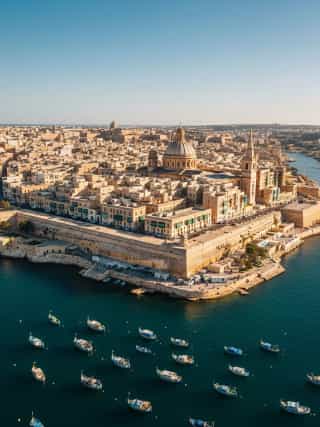
Valletta - The Capital of Malta
- Population
- 6,444
- Language
- Maltese
- Continent
- Europe
- Since
- 1571
- Eco Ranking
- 14/195
Source: Environmental Performance Index 2024.
About Valletta
Valletta is the smallest capital city in the European Union by both population and area, yet its historical and political significance is disproportionate to its size. The city was founded in 1566 by Jean de Valette, Grand Master of the Order of St. John, as a direct response to the Great Siege of Malta of 1565, in which Ottoman forces besieged the island for nearly four months before being repelled. De Valette's decision to build a fortified city on the Sciberras Peninsula created one of the most heavily fortified urban settlements in Europe, planned from the outset on a grid layout. Valletta served as the seat of the Knights of St. John until Napoleon captured Malta in 1798, nominally ending the Knights' rule. The British subsequently took control in 1800, and Malta became a key naval base in the Mediterranean. During World War II, Malta, and Valletta, endured sustained aerial bombardment by German and Italian forces, suffering some of the most intense bombing of the war. In recognition, King George VI awarded the George Cross to Malta in 1942, a collective military honour unique in British history, awarded to the entire island rather than an individual. Malta gained independence in 1964 and became a republic in 1974. It joined the European Union in 2004 and adopted the euro in 2008. Valletta today houses the Office of the President, the Prime Minister's Office, and the Parliament of Malta.
About Malta
Malta is a parliamentary republic. The President is head of state with a ceremonial role; the Prime Minister leads the government. Malta is a member of the EU and the Eurozone, and a member of the Commonwealth. It has a strategic location at the centre of the Mediterranean, between Europe and North Africa. Malta's political scene has been dominated by two main parties, the Nationalist Party and the Labour Party, since independence. Malta has been a significant destination for asylum seekers crossing the Mediterranean.
View Valletta on the map
Flight time from Valletta to other capitals
| City | Distance (km) | Flight Time |
|---|---|---|
| Rome | 700 | 0h 49m |
| Paris | 1700 | 2h 0m |
| London | 2100 | 2h 28m |
| Abu Dhabi | 4000 | 4h 42m |
| Washington, D.C. | 7700 | 9h 4m |
| Cape Town | 7800 | 9h 11m |
| Singapore | 9900 | 11h 39m |
| Tokyo | 10200 | 12h 0m |
| Buenos Aires | 10900 | 12h 49m |
| Canberra | 15900 | 18h 42m |
Capitals with similar population to Valletta
| City | Population |
|---|---|
| St. George's | 7,500 |
| Palikir | 6,647 |
| Valletta | 6,444 |
| Funafuti | 6,320 |
| Vaduz | 5,696 |
| San Marino | 4,061 |
| Yaren | 1,100 |
Capitals with similar eco ranking to Valletta
Source: Environmental Performance Index 2024.
Frequently Asked Questions
Why is Valletta so small?
Valletta was built on the narrow Sciberras Peninsula as a purpose-built fortified city after the 1565 Great Siege. Its boundaries were determined by the peninsula's physical constraints. The city was designed for defence, not expansion. As Malta urbanised, development spread into surrounding areas, leaving Valletta itself with a small and declining resident population of around 6,000.
Who founded Valletta and why?
Valletta was founded in 1566 by Jean de Valette, Grand Master of the Knights of St. John, following the near-successful Ottoman siege of Malta in 1565. De Valette ordered the construction of a new fortified city to replace the less defensible earlier capital, Mdina. Pope Pius V and European monarchs contributed funding to the project. The city was named after its founder.
What was the George Cross awarded to Malta?
On 15 April 1942, King George VI awarded the George Cross collectively to the island of Malta, specifically 'to the island fortress of Malta' and its people, in recognition of the extraordinary suffering and resistance during sustained German and Italian aerial bombardment from 1940 to 1942. It was the only time the George Cross was awarded to a collective population rather than an individual. The cross appears on Malta's national flag.
When did Malta join the European Union?
Malta joined the European Union on 1 May 2004, along with nine other countries in the EU's largest expansion. Malta adopted the euro on 1 January 2008. EU membership significantly shaped Malta's economic and regulatory environment, and the country became a significant financial services and online gaming hub within the single market.
Is Valletta the smallest capital in the EU?
Yes. Valletta is the smallest capital city in the European Union by both population and area. Its resident population is approximately 6,400, and the city covers about 0.8 square kilometres. Luxembourg City and Nicosia are also small EU capitals, but Valletta is the smallest. Despite its size, it serves as Malta's full seat of government and diplomatic centre.
Sights and landmarks
Climate and best time to visit
Culture and customs