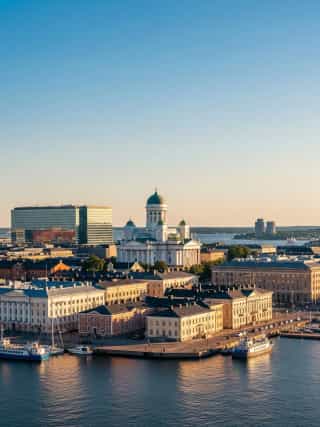
Helsinki - The Capital of Finland
- Population
- 658,864
- Language
- Finnish
- Continent
- Europe
- Since
- 1812
- Eco Ranking
- 4/195
Source: Environmental Performance Index 2024.
About Helsinki
Helsinki became the capital of Finland in 1812, by decree of Tsar Alexander I of Russia, who had incorporated Finland into the Russian Empire as an autonomous Grand Duchy in 1809. The designation of Helsinki as capital was a deliberate strategic and political decision: it replaced Turku, the historical center of Finnish civic life, which was located too close to Sweden, Russia's rival, and too far from St. Petersburg, where the Tsar held court. Helsinki's position on the southern coast made it geographically closer to the Russian imperial capital and easier to monitor and supply. To reinforce its status, Alexander I commissioned a massive neoclassical rebuilding of the city under the architect Carl Ludwig Engel, giving Helsinki a monumental center designed to project Russian imperial authority. When Finland declared independence on December 6, 1917, following the Russian Revolution, Helsinki became the capital of a newly sovereign republic. The city was briefly the site of a brutal civil war in 1918 between White and Red Finnish factions. Today, Helsinki houses the Finnish Parliament (Eduskunta), the President's Office, the Supreme Court, and the Council of State. Finland joined NATO in April 2023, fundamentally altering the security context of the Finnish capital, which sits less than 400 kilometers from St. Petersburg.
About Finland
Finland is a parliamentary republic with a semi-presidential system, in which both the president and the prime minister hold executive authority. Finland was an autonomous Grand Duchy of Russia from 1809 until declaring independence in 1917. It joined the European Union in 1995 and, after decades of military non-alignment, became a NATO member in April 2023 following Russia's invasion of Ukraine. Finland consistently ranks among the world's highest for press freedom, governance quality, and institutional trust.
View Helsinki on the map
Flight time from Helsinki to other capitals
| City | Distance (km) | Flight Time |
|---|---|---|
| London | 1800 | 2h 7m |
| Paris | 1900 | 2h 14m |
| Rome | 2200 | 2h 35m |
| Abu Dhabi | 4600 | 5h 25m |
| Washington, D.C. | 6900 | 8h 7m |
| Tokyo | 7800 | 9h 11m |
| Singapore | 9300 | 10h 56m |
| Cape Town | 10500 | 12h 21m |
| Buenos Aires | 13000 | 15h 18m |
| Canberra | 15200 | 17h 53m |
Capitals with similar population to Helsinki
| City | Population |
|---|---|
| Oslo | 697,549 |
| Washington, D.C. | 689,545 |
| Chișinău | 685,889 |
| Helsinki | 658,864 |
| Copenhagen | 658,390 |
| Djibouti | 623,891 |
| Riga | 614,618 |
Capitals with similar eco ranking to Helsinki
Source: Environmental Performance Index 2024.
Frequently Asked Questions
Why did Russia make Helsinki the capital of Finland?
Tsar Alexander I chose Helsinki over the existing capital Turku in 1812 because Helsinki was closer to St. Petersburg and further from Sweden. The move was strategically motivated: it kept the Finnish capital within easier reach of Russian imperial authority and reduced the influence of Sweden over Finnish political life.
When did Helsinki become the capital of an independent Finland?
Helsinki became the capital of independent Finland on December 6, 1917, when Finland declared independence from Russia following the October Revolution. The city had been the administrative capital since 1812 but under Russian imperial rule.
Was Helsinki always the most important city in Finland?
No. Before 1812, Turku was the dominant city in Finland, the center of trade, education, and the Lutheran church. Helsinki was a small, relatively insignificant coastal town before the Russian Empire redesignated it as capital and funded its expansion.
What happened in Helsinki during the 1918 Finnish Civil War?
Helsinki was briefly occupied by Red Guards at the start of the civil war in January 1918. It was retaken by White Finnish forces, supported by German troops, in April 1918. The civil war resulted in roughly 36,000 deaths, including large numbers from imprisonment and famine.
How has Finland's NATO membership changed Helsinki's strategic position?
Finland joined NATO in April 2023, ending decades of military non-alignment. This placed Helsinki, located less than 400 kilometers from St. Petersburg, within a NATO member state for the first time, significantly altering the strategic balance on Russia's northwestern border.
Sights and landmarks
Climate and best time to visit
Culture and customs
Economy