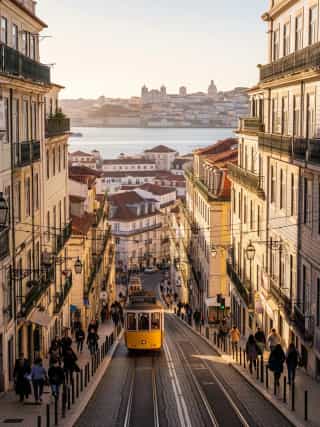
Lisbon - The Capital of Portugal
- Population
- 2,963,929
- Language
- Portuguese
- Continent
- Europe
- Since
- 1255
- Eco Ranking
- 26/195
Source: Environmental Performance Index 2024.
About Lisbon
Lisbon has served as Portugal's capital since 1255, when King Afonso III transferred the royal seat from Coimbra. The city subsequently became the operational center of one of history's earliest and most extensive maritime empires, directing trade routes to Africa, Asia, and the Americas from the late 15th century onward. On 1 November 1755, a catastrophic earthquake and tsunami killed tens of thousands and destroyed much of the historic city. The reconstruction was directed by the Marquis of Pombal, chief minister to King José I, who rebuilt the Pombaline Lower Town (Baixa Pombalina) in a rationalist grid, one of the first planned urban reconstructions in European history. Portugal's modern political history was defined by the Estado Novo dictatorship, established by António de Oliveira Salazar in 1933 and continued under Marcelo Caetano, which ruled from Lisbon until the Carnation Revolution of 25 April 1974, a largely bloodless military coup that restored democracy. Lisbon is the seat of the Assembly of the Republic, the presidency, and the Constitutional Court. Portugal is the oldest continuously existing nation-state in Europe, with borders largely unchanged since the 12th century.
About Portugal
Portugal is a unitary semi-presidential republic on the western edge of the Iberian Peninsula. It was Europe's first global colonial power, with an empire that lasted from the 15th to the late 20th century, including the handover of Macau to China in 1999. Portugal joined the European Community in 1986 and was a founding member of the eurozone. The 1974 Carnation Revolution ended 48 years of authoritarian rule and established the current democratic constitution of 1976. Portugal is a member of NATO, which it helped found in 1949.
View Lisbon on the map
Flight time from Lisbon to other capitals
| City | Distance (km) | Flight Time |
|---|---|---|
| Paris | 1500 | 1h 46m |
| London | 1600 | 1h 53m |
| Rome | 1900 | 2h 14m |
| Washington, D.C. | 5700 | 6h 42m |
| Abu Dhabi | 6100 | 7h 11m |
| Cape Town | 8600 | 10h 7m |
| Buenos Aires | 9600 | 11h 18m |
| Tokyo | 11100 | 13h 4m |
| Singapore | 11900 | 14h 0m |
| Canberra | 18100 | 21h 18m |
Capitals with similar population to Lisbon
| City | Population |
|---|---|
| Lisbon | 2,963,929 |
| Kyiv | 2,962,180 |
| Sana'a | 2,961,837 |
| Caracas | 2,935,744 |
| Guatemala City | 2,918,337 |
| Tashkent | 2,906,000 |
| Buenos Aires | 2,890,151 |
Capitals with similar eco ranking to Lisbon
Source: Environmental Performance Index 2024.
Frequently Asked Questions
When did Lisbon become the capital of Portugal?
Lisbon became the capital of Portugal in 1255 when King Afonso III moved the royal court from Coimbra. Portugal itself had existed as a kingdom since 1143, making Lisbon a relatively late addition as capital in the country's medieval history.
What was the Carnation Revolution and why did it happen in Lisbon?
The Carnation Revolution was a military coup launched on 25 April 1974 by the Armed Forces Movement (MFA), a group of officers opposed to Portugal's authoritarian Estado Novo regime and its costly colonial wars in Africa. The coup was centered in Lisbon, where key military units seized government buildings, radio stations, and the airport. The name derives from the carnations that civilians placed in the barrels of soldiers' guns.
How did the 1755 earthquake change Lisbon?
The earthquake of 1 November 1755, followed by a tsunami and fires, devastated Lisbon, killing estimates ranging from 10,000 to 100,000 people. The Marquis of Pombal oversaw a rapid and systematic reconstruction that reshaped the city center into a rationalist grid. The rebuilt Baixa district remains one of Europe's most coherent examples of 18th-century urban planning.
Was Lisbon the center of Portugal's colonial empire?
Yes. From the late 15th century, Lisbon served as the administrative and commercial hub of the Portuguese Empire, which at its peak spanned Brazil, Angola, Mozambique, Goa, Macau, and dozens of other territories. The wealth generated by maritime trade transformed Lisbon into one of Europe's wealthiest cities in the 16th century. Portugal's last overseas territory, Macau, was transferred to China in 1999.
Is Lisbon the largest city in Portugal?
Yes, Lisbon is the largest city in Portugal, with a metropolitan area population of roughly 2.96 million, representing about 30 percent of the country's total population. Porto is the second-largest city. The Lisbon metropolitan area generates a disproportionate share of Portugal's GDP.
Sights and landmarks
Climate and best time to visit
Culture and customs