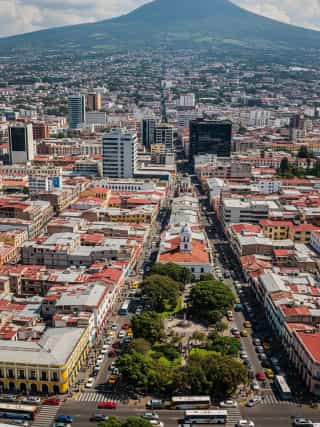
Guatemala City - The Capital of Guatemala
- Population
- 2,918,337
- Language
- Spanish
- Continent
- North America
- Since
- 1776
- Eco Ranking
- 167/195
Source: Environmental Performance Index 2024.
About Guatemala City
Guatemala City became the capital of Guatemala in 1776, following a catastrophic series of earthquakes in 1773, known as the Santa Marta earthquakes, that destroyed the previous capital, Santiago de los Caballeros de Guatemala, now called Antigua Guatemala. Colonial authorities debated whether to rebuild Antigua or relocate the capital; the decision to move was contentious and resisted by many residents who remained in the ruins of the old city. The new capital was formally established in the Valley of the Hermitage and quickly assumed the administrative, ecclesiastical, and commercial functions of its predecessor. When Central America declared independence from Spain in 1821, Guatemala City became the capital of the Federal Republic of Central America, and later of the independent Republic of Guatemala. The city experienced significant US political interference during the Cold War: in 1954, the CIA backed a coup that overthrew the democratically elected President Jacobo Árbenz, initiating decades of military rule and a civil war that lasted until 1996. Today, Guatemala City houses the Congress of the Republic, the presidency, and the Supreme Court. It is the most populous city in Central America.
About Guatemala
Guatemala is a presidential republic in Central America with a unicameral Congress of the Republic. It has the largest population in Central America and significant Indigenous Mayan populations that constitute roughly 40% of citizens. Guatemala experienced a 36-year civil war from 1960 to 1996, one of the longest and most destructive conflicts in Latin American history. The country has faced persistent challenges around corruption, judicial independence, and democratic backsliding, with significant emigration to the United States.
View Guatemala City on the map
Flight time from Guatemala City to other capitals
| City | Distance (km) | Flight Time |
|---|---|---|
| Washington, D.C. | 3000 | 3h 32m |
| Buenos Aires | 6400 | 7h 32m |
| London | 8800 | 10h 21m |
| Paris | 9000 | 10h 35m |
| Rome | 10000 | 11h 46m |
| Tokyo | 12300 | 14h 28m |
| Cape Town | 12600 | 14h 49m |
| Canberra | 13700 | 16h 7m |
| Abu Dhabi | 14200 | 16h 42m |
| Singapore | 17600 | 20h 42m |
Capitals with similar population to Guatemala City
Capitals with similar eco ranking to Guatemala City
Source: Environmental Performance Index 2024.
Frequently Asked Questions
Why did Guatemala move its capital to Guatemala City?
The 1773 Santa Marta earthquakes devastated the previous capital, Antigua Guatemala (then called Santiago de los Caballeros). Colonial authorities decided to relocate rather than rebuild, and a new capital was founded in the Valley of the Hermitage in 1776.
When did Guatemala City become the capital?
Guatemala City was officially established as the capital in 1776, three years after the earthquakes destroyed Antigua. It assumed full capital status when Central America declared independence from Spain in 1821.
Is Guatemala City the largest city in Central America?
Yes, the Guatemala City metropolitan area is the most populous urban area in Central America, with a population exceeding 2.9 million in the city itself and considerably more in the wider metro region.
What happened in Guatemala City in 1954?
In 1954, a CIA-backed military coup overthrew President Jacobo Árbenz, who had enacted land reform policies that threatened the interests of the United Fruit Company. The coup ended Guatemala's democratic experiment and initiated a long period of military rule and political violence.
What government institutions are located in Guatemala City?
Guatemala City houses the Congress of the Republic, the Office of the President, the Supreme Court of Justice, and the headquarters of all government ministries. It is the complete political, administrative, and judicial center of the country.
Sights and landmarks
Climate and best time to visit
Regional significance
Economy