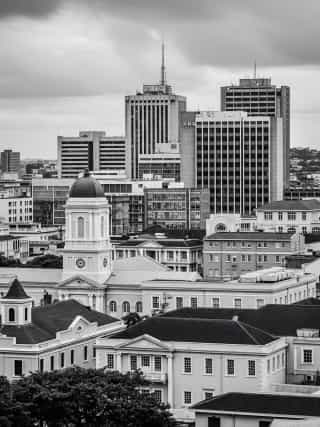
Kingstown - The Capital of Saint Vincent and the Grenadines
- Population
- 12,909
- Language
- English
- Continent
- North America
- Since
- 1719
- Eco Ranking
- 42/195
Source: Environmental Performance Index 2024.
About Kingstown
Kingstown is the capital and largest settlement of Saint Vincent and the Grenadines, a Caribbean island nation comprising the main island of Saint Vincent and a chain of smaller islands to the south. The town was established by French colonizers in the early 18th century and served as the administrative seat during a prolonged period of contest between French and British colonial powers. Britain gained definitive control of Saint Vincent in 1783 under the Treaty of Paris, and Kingstown continued as the colonial capital under British rule. The island's colonial history was marked by conflict with the indigenous Garifuna people, of mixed Carib, Arawak, and African descent, who resisted European colonization. The British deported the majority of the Garifuna population to the Bay Islands of Honduras in 1797 following the Second Carib War, a forced displacement that fundamentally altered the island's demographics. Saint Vincent and the Grenadines gained independence from Britain on October 27, 1979, with Kingstown as its capital. The country is governed as a parliamentary democracy with the British monarch as head of state. Kingstown houses the House of Assembly and the offices of the prime minister. With a population of under 13,000, it is one of the smallest national capitals in the Western Hemisphere. In April 2021, the La Soufrière volcano on Saint Vincent erupted, forcing the evacuation of a significant portion of the island's northern population.
About Saint Vincent and the Grenadines
Saint Vincent and the Grenadines is a parliamentary democracy and constitutional monarchy with the British monarch as head of state. It gained independence from Britain in 1979 and is a member of CARICOM and the Organisation of Eastern Caribbean States (OECS). The country's colonial history included the forced deportation of the indigenous Garifuna population to Central America in 1797. The nation is vulnerable to natural disasters, including volcanic eruptions from La Soufrière and Atlantic hurricanes. It is one of the smallest sovereign states in the Western Hemisphere.
View Kingstown on the map
Flight time from Kingstown to other capitals
| City | Distance (km) | Flight Time |
|---|---|---|
| Washington, D.C. | 3300 | 3h 53m |
| Buenos Aires | 5300 | 6h 14m |
| London | 6900 | 8h 7m |
| Paris | 7000 | 8h 14m |
| Rome | 7700 | 9h 4m |
| Cape Town | 9900 | 11h 39m |
| Abu Dhabi | 11900 | 14h 0m |
| Tokyo | 14200 | 16h 42m |
| Canberra | 16100 | 18h 56m |
| Singapore | 17700 | 20h 49m |
Capitals with similar population to Kingstown
| City | Population |
|---|---|
| Belmopan | 16,451 |
| Roseau | 14,725 |
| Basseterre | 14,000 |
| Kingstown | 12,909 |
| St. George's | 7,500 |
| Palikir | 6,647 |
| Valletta | 6,444 |
Capitals with similar eco ranking to Kingstown
| City | Eco Rank |
|---|---|
| St. John's | 39 |
| San José | 40 |
| Kyiv | 41 |
| Kingstown | 42 |
| Nicosia | 44 |
| Caracas | 45 |
| Libreville | 45 |
Source: Environmental Performance Index 2024.
Frequently Asked Questions
When did Kingstown become the capital of Saint Vincent and the Grenadines?
Kingstown has served as the administrative capital since the colonial period under British rule and became the capital of independent Saint Vincent and the Grenadines on October 27, 1979, when the country gained independence from Britain.
Why is Kingstown such a small capital city?
Saint Vincent and the Grenadines has a total population of approximately 110,000, making it one of the smallest sovereign nations in the Western Hemisphere. Kingstown, as the main settlement on the main island, reflects the scale of the country itself rather than representing unusual underdevelopment for a Caribbean state.
What happened to the Garifuna people of Saint Vincent?
The Garifuna, a people of mixed Carib, Arawak, and African descent, resisted British colonization of Saint Vincent. Following their defeat in the Second Carib War in 1796-1797, the British forcibly deported the majority of the Garifuna population to Roatan Island (in present-day Honduras), from where they dispersed along the Central American coast. Descendants continue to live in Honduras, Guatemala, Belize, and Nicaragua.
What happened during the 2021 volcanic eruption near Kingstown?
La Soufrière volcano on Saint Vincent erupted in April 2021, after months of increased activity. The eruption forced the evacuation of approximately 20,000 people from the island's northern zones. Ashfall affected Kingstown and large parts of the island. The eruption was the most significant on Saint Vincent since 1979 and caused substantial agricultural and infrastructural damage.
Is Saint Vincent and the Grenadines still a monarchy?
Yes. Saint Vincent and the Grenadines is a constitutional monarchy with the British monarch as head of state, represented locally by a governor-general. The country is governed by a prime minister and the unicameral House of Assembly in Kingstown. As of 2024, no formal steps toward becoming a republic have been enacted.
Sights and landmarks
Climate and best time to visit
Regional significance
Economy