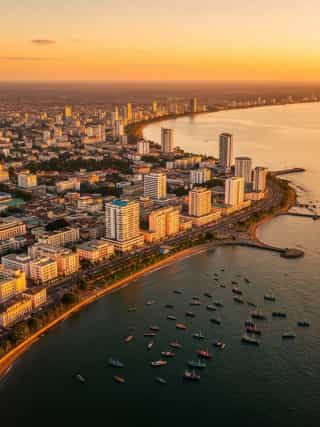
Libreville - The Capital of Gabon
- Population
- 797,003
- Language
- French
- Continent
- Africa
- Since
- 1960
- Eco Ranking
- 45/195
Source: Environmental Performance Index 2024.
About Libreville
Libreville, French for 'free town', was founded in 1849 as a settlement for freed enslaved people intercepted by the French Navy from a slave ship, making it one of a handful of African capitals with an explicit abolitionist origin, alongside Freetown in Sierra Leone and Monrovia in Liberia. It became the capital of Gabon upon independence from France on 17 August 1960. For 56 years, Gabon was governed by the Bongo family: Omar Bongo ruled from 1967 until his death in 2009, after which his son Ali Bongo assumed the presidency. This dynasty, backed by French political and economic interests, presided over a state heavily dependent on oil revenues while poverty remained widespread. On 30 August 2023, a military coup removed Ali Bongo immediately after a disputed election result, ending one of Africa's longest-ruling dynasties. General Brice Oligui Nguema was installed as transitional leader. Libreville concentrates the majority of Gabon's population and virtually all of its governmental, commercial, and media institutions. The city sits on the Komo River estuary on Gabon's Atlantic coast. Gabon is one of the few sub-Saharan African countries to maintain a rainforest cover exceeding 85 percent of its territory.
About Gabon
Gabon is a Central African state on the Atlantic coast, independent from France since 1960 and historically classified as a middle-income country due to oil revenues. The country is a member of the African Union and the Economic Community of Central African States. Following the 2023 military coup, a transitional government suspended the constitution and dissolved state institutions. France, the former colonial power, maintained close political and economic ties with Gabon throughout the Bongo era, a relationship characteristic of the Françafrique system of post-colonial influence.
View Libreville on the map
Flight time from Libreville to other capitals
| City | Distance (km) | Flight Time |
|---|---|---|
| Cape Town | 3900 | 4h 35m |
| Rome | 4600 | 5h 25m |
| Paris | 5400 | 6h 21m |
| Abu Dhabi | 5500 | 6h 28m |
| London | 5800 | 6h 49m |
| Buenos Aires | 8000 | 9h 25m |
| Washington, D.C. | 9700 | 11h 25m |
| Singapore | 10500 | 12h 21m |
| Tokyo | 13500 | 15h 53m |
| Canberra | 14300 | 16h 49m |
Capitals with similar population to Libreville
Capitals with similar eco ranking to Libreville
Source: Environmental Performance Index 2024.
Frequently Asked Questions
Why is Libreville called 'Libreville'?
Libreville means 'free town' in French. The settlement was established in 1849 by the French Navy as a home for enslaved Africans freed from a slave ship. The name reflects this origin and parallels other abolitionist-founded capitals: Freetown in Sierra Leone (founded by British abolitionists) and Monrovia in Liberia (founded by freed American slaves).
When did Libreville become the capital of Gabon?
Libreville became the capital of an independent Gabon on 17 August 1960, when Gabon gained independence from France. The city had previously served as the capital of French Gabon within French Equatorial Africa.
What happened in Gabon's 2023 coup?
On 30 August 2023, the Gabonese military seized power immediately after the announcement of election results that gave Ali Bongo a third term. Officers placed Bongo under house arrest and installed General Brice Oligui Nguema as transitional president. The coup ended 56 years of rule by the Bongo family, which began when Omar Bongo took power in 1967.
How long did the Bongo family rule Gabon?
The Bongo family ruled Gabon for 56 years. Omar Bongo held power from 1967 until his death in 2009, one of the longest individual presidential tenures in African history. His son Ali Bongo then won elections in 2009 and 2016 and was in office when the military removed him in August 2023.
Is Libreville the largest city in Gabon?
Yes, Libreville is by far the largest city in Gabon, home to more than half of the country's total population of roughly 2.3 million. The extreme concentration of population and economic activity in Libreville reflects a pattern common to many post-colonial African states where the colonial administrative center absorbed most subsequent urban growth.
Sights and landmarks
Climate and best time to visit
Economy