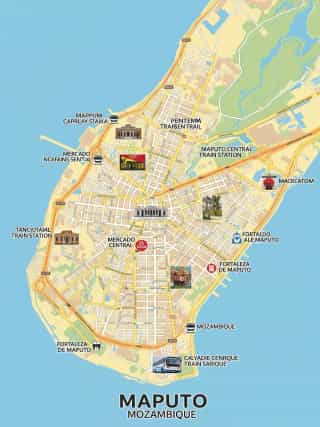
Maputo - The Capital of Mozambique
- Population
- 1,101,170
- Language
- Portuguese
- Continent
- Africa
- Since
- 1975
- Eco Ranking
- 132/195
Source: Environmental Performance Index 2024.
About Maputo
Maputo, known as Lourenço Marques under Portuguese colonial rule, became the capital of independent Mozambique on 25 June 1975 and was renamed Maputo in 1976. Founded as a Portuguese trading post in the late 18th century and developed as a port city in the 19th century, it served as the administrative capital of Portuguese East Africa. Mozambique's independence was achieved after a ten-year armed liberation war by FRELIMO (Frente de Libertação de Moçambique), which immediately assumed single-party governance. A civil war between FRELIMO and RENAMO (Resistência Nacional Moçambicana), backed at various points by Rhodesia and apartheid South Africa, lasted from 1977 to 1992, causing approximately one million deaths and displacing millions more. Maputo, as the FRELIMO government's seat, was the political and military center of the conflict. A peace agreement in 1992 ended the war, and multiparty elections followed in 1994. FRELIMO has governed Mozambique without interruption since independence, though RENAMO has participated in subsequent elections and intermittent armed hostilities recurred between 2013 and 2019. Maputo is the seat of the Assembly of the Republic, the presidency, and the main government institutions. A large natural gas discovery off Mozambique's coast has transformed the country's geopolitical significance since the 2010s.
About Mozambique
Mozambique is a southeastern African state on the Indian Ocean coast, bordered by Tanzania, Malawi, Zambia, Zimbabwe, South Africa, and Eswatini. It gained independence from Portugal in 1975. FRELIMO has governed continuously since independence, initially as a Marxist-Leninist party. The country has held multiparty elections since 1994 but FRELIMO has won all of them. Mozambique remains one of the world's poorest countries despite its natural resources. A jihadist insurgency in the northern Cabo Delgado province, which erupted in 2017, has complicated plans to develop offshore gas fields.
View Maputo on the map
Flight time from Maputo to other capitals
| City | Distance (km) | Flight Time |
|---|---|---|
| Cape Town | 1600 | 1h 53m |
| Abu Dhabi | 6100 | 7h 11m |
| Rome | 7800 | 9h 11m |
| Singapore | 8200 | 9h 39m |
| Buenos Aires | 8500 | 10h 0m |
| Paris | 8800 | 10h 21m |
| London | 9200 | 10h 49m |
| Canberra | 10500 | 12h 21m |
| Tokyo | 13100 | 15h 25m |
| Washington, D.C. | 13400 | 15h 46m |
Capitals with similar population to Maputo
Capitals with similar eco ranking to Maputo
| City | Eco Rank |
|---|---|
| Asunción | 130 |
| Kinshasa | 130 |
| Khartoum | 131 |
| Bangui | 132 |
| Maputo | 132 |
| Sri Jayawardenepura Kotte | 133 |
| Mbabane | 134 |
Source: Environmental Performance Index 2024.
Frequently Asked Questions
Why was Maputo called Lourenço Marques?
The city was named Lourenço Marques after a Portuguese trader who explored the Maputo Bay area in the early 16th century. The Portuguese colonial administration used this name throughout the colonial period. Upon Mozambican independence in 1975, the new FRELIMO government renamed it Maputo in 1976, after the Maputo River, as part of a broader decolonization of place names.
When did Maputo become the capital of Mozambique?
Maputo (then Lourenço Marques) became the capital of independent Mozambique on 25 June 1975, the day Mozambique gained independence from Portugal. The city had served as the capital of Portuguese East Africa under colonial rule. The name change to Maputo followed in 1976.
What was the Mozambican Civil War?
The Mozambican Civil War lasted from 1977 to 1992, pitting the FRELIMO government against RENAMO, an armed opposition group initially supported by Rhodesia and then by apartheid South Africa. The war caused an estimated one million deaths and displaced approximately five million people. It ended with the Rome General Peace Accords signed on 4 October 1992, followed by multiparty elections in 1994.
Who is FRELIMO and how long have they governed Mozambique?
FRELIMO (Frente de Libertação de Moçambique) was the liberation movement that led Mozambique's armed struggle for independence from Portugal, beginning in 1964. It has governed the country since independence in 1975, more than 50 years, making it one of Africa's longest-ruling parties. FRELIMO governed initially as a Marxist-Leninist vanguard party, then transitioned to a nominally multiparty system after 1994.
Is Maputo the largest city in Mozambique?
Yes, Maputo is the largest city in Mozambique, with approximately 1.1 million people in the city and over 2 million in the greater metropolitan area. It is significantly larger than the second-largest city, Matola (which is part of the Maputo metropolitan area) and Beira. Maputo's dominance reflects its role as the country's main port, financial center, and seat of government.
Sights and landmarks
Climate and best time to visit
Culture and customs