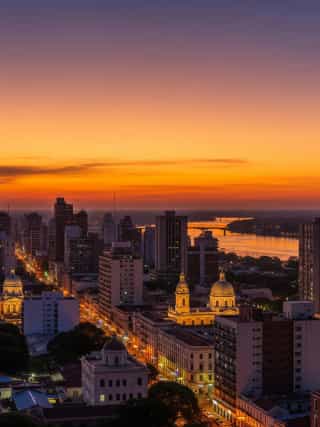
Asunción - The Capital of Paraguay
- Population
- 3,222,000
- Language
- Spanish
- Continent
- South America
- Since
- 1811
- Eco Ranking
- 130/195
Source: Environmental Performance Index 2024.
About Asunción
Asunción is one of the oldest continuously inhabited cities in South America, founded by Spanish conquistadors on 15 August 1537, decades before Buenos Aires was permanently settled. It served as the administrative hub of a vast Spanish colonial territory, functioning as the 'Mother of Cities' from which other settlements including Buenos Aires were re-founded or supplied. Paraguay declared independence from Spain on 14 May 1811, and Asunción became the capital of one of South America's most isolated republics. The country's geography, landlocked, surrounded by more powerful neighbors, shaped a political history marked by authoritarianism and devastating conflict. The War of the Triple Alliance (1864-1870) against Argentina, Brazil, and Uruguay killed an estimated 60-70% of Paraguay's population, one of the most catastrophic losses suffered by any nation in modern history. Asunción was the seat of the long Stroessner dictatorship (1954-1989), one of South America's longest-running authoritarian regimes. Today it houses the National Congress, the Supreme Court, and the presidential Palace of the López. Paraguay has no second city that rivals Asunción in administrative weight.
About Paraguay
Paraguay is a presidential republic with a bicameral Congress. It has operated under its current constitution since 1992, adopted after the fall of the Stroessner dictatorship. The Colorado Party has dominated Paraguayan politics for most of the country's modern history. Paraguay is a landlocked country bordering Argentina, Brazil, and Bolivia. It has one of the most unequal land distributions in the world, with a small number of families controlling the majority of agricultural land.
View Asunción on the map
Flight time from Asunción to other capitals
| City | Distance (km) | Flight Time |
|---|---|---|
| Buenos Aires | 1000 | 1h 11m |
| Cape Town | 7200 | 8h 28m |
| Washington, D.C. | 7400 | 8h 42m |
| London | 10200 | 12h 0m |
| Paris | 10200 | 12h 0m |
| Rome | 10400 | 12h 14m |
| Canberra | 12700 | 14h 56m |
| Abu Dhabi | 13200 | 15h 32m |
| Singapore | 16700 | 19h 39m |
| Tokyo | 18000 | 21h 11m |
Capitals with similar population to Asunción
| City | Population |
|---|---|
| Addis Ababa | 3,352,000 |
| Santo Domingo | 3,339,410 |
| Pyongyang | 3,255,288 |
| Asunción | 3,222,000 |
| Athens | 3,090,508 |
| Antananarivo | 3,058,800 |
| Brasília | 3,055,149 |
Capitals with similar eco ranking to Asunción
Source: Environmental Performance Index 2024.
Frequently Asked Questions
When was Asunción founded?
Asunción was founded on 15 August 1537 by Spanish explorer Juan de Salazar de Espinosa. It is one of the oldest continually inhabited cities in South America and predates the permanent settlement of Buenos Aires by several decades. It served as the base for Spanish colonial expansion across the Río de la Plata region.
When did Asunción become the capital of independent Paraguay?
Asunción became the capital of independent Paraguay on 14 May 1811, when the country declared independence from Spanish colonial rule and from the authority of Buenos Aires. Paraguay was one of the first countries in the region to achieve independence.
What was the impact of the War of the Triple Alliance on Asunción?
The War of the Triple Alliance (1864-1870), in which Paraguay fought simultaneously against Argentina, Brazil, and Uruguay, was catastrophic for the country. Brazilian forces occupied Asunción in 1869. Estimates suggest that up to 60-70% of Paraguay's total population perished, and the country lost significant territory to its neighbors in the subsequent peace settlement.
Is Asunción the largest city in Paraguay?
Yes, in terms of political and administrative significance. The metropolitan area of greater Asunción (including neighboring cities like Luque, San Lorenzo, and Fernando de la Mora) has a population of over 3 million. No other Paraguayan city comes close in terms of governmental or economic concentration.
What was the Stroessner dictatorship and where did it rule from?
Alfredo Stroessner governed Paraguay from Asunción from 1954 to 1989, making his regime one of the longest-lasting dictatorships in South American history. He ruled through the Colorado Party and the military, suppressing political opposition and overseeing significant human rights abuses. He was ousted in a coup by his own general, Andrés Rodríguez, in February 1989.
Sights and landmarks
Climate and best time to visit
Culture and customs
Economy