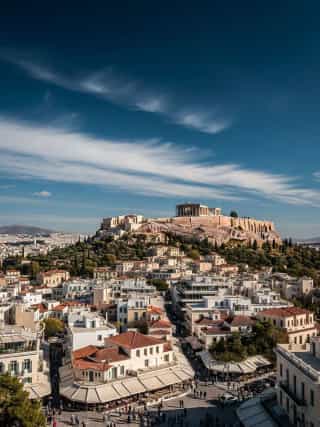
Athens - The Capital of Greece
- Population
- 3,090,508
- Language
- Greek
- Continent
- Europe
- Since
- 1834
- Eco Ranking
- 12/195
Source: Environmental Performance Index 2024.
About Athens
Athens has been the capital of the modern Greek state since 1834, but it was not the first. When Greece won independence from the Ottoman Empire, Nafplio served as the capital from 1829 to 1834. Athens was chosen by the newly installed Bavarian king, Otto I, as the capital of the Kingdom of Greece partly for its ancient symbolic weight, the city lent legitimacy to the modern state's claim of continuity with classical antiquity. At the time of its selection, Athens was a small town of only a few thousand people, its ancient monuments largely in ruins, the surrounding area underpopulated after centuries of Ottoman rule. A Bavarian team of architects drew up the plans for the modern city. Greece's political history since independence has included periods of monarchy, military dictatorship, and democracy. The Greek military junta governed from Athens between 1967 and 1974, a period known as the Regime of the Colonels. The restoration of democracy in 1974 (Metapolitefsi) established the current parliamentary republic. Athens is now home to the Hellenic Parliament, the Office of the President, and the Supreme Court. The city contains approximately one third of Greece's total population.
About Greece
Greece is a parliamentary republic whose current constitution dates to 1975, adopted after the fall of the military junta. The President is elected by Parliament and performs largely ceremonial functions; executive authority rests with the Prime Minister. Greece is a member of the EU and NATO. It experienced a severe sovereign debt crisis from 2010 to 2018, during which it became the first developed country to default on an IMF loan, necessitating three international bailout programs.
View Athens on the map
Flight time from Athens to other capitals
| City | Distance (km) | Flight Time |
|---|---|---|
| Rome | 1100 | 1h 18m |
| Paris | 2100 | 2h 28m |
| London | 2400 | 2h 49m |
| Abu Dhabi | 3300 | 3h 53m |
| Cape Town | 8000 | 9h 25m |
| Washington, D.C. | 8300 | 9h 46m |
| Singapore | 9000 | 10h 35m |
| Tokyo | 9500 | 11h 11m |
| Buenos Aires | 11700 | 13h 46m |
| Canberra | 15200 | 17h 53m |
Capitals with similar population to Athens
Capitals with similar eco ranking to Athens
Source: Environmental Performance Index 2024.
Frequently Asked Questions
Was Athens always the capital of Greece?
No. Nafplio was the first capital of the modern Greek state, from 1829 to 1834. Athens was selected as the capital by King Otto I in 1834, partly for its symbolic significance as the center of ancient Greek civilization. At the time, Athens was a small town of a few thousand people.
When did Athens become the capital of Greece?
Athens became the capital of the Kingdom of Greece in 1834, three years after the Greek state was formally recognized following the War of Independence. King Otto I, installed by the European powers, chose Athens over Nafplio to leverage the symbolic power of the ancient city for his new kingdom.
What was the Greek military junta and where did it govern from?
The Greek military junta, known as the Regime of the Colonels, seized power in a coup on 21 April 1967 and governed Greece from Athens until July 1974. The junta suspended the constitution, abolished political parties, and engaged in systematic torture of political opponents. It collapsed after a disastrous military intervention in Cyprus.
Is Athens the largest city in Greece?
Yes. Athens and its surrounding metropolitan area (Attica) is home to approximately 3.7 million people, around one third of Greece's total population. This high degree of centralization in the capital is a structural feature of the Greek state and economy.
What is the seat of the Greek government in Athens?
The Hellenic Parliament is housed in the former Royal Palace on Syntagma Square in central Athens. The Prime Minister's office is at the Maximos Mansion. The Presidential Palace serves as the official residence of the President of the Republic. All major constitutional institutions are concentrated in Athens.
Sights and landmarks
Climate and best time to visit
Regional significance
Economy