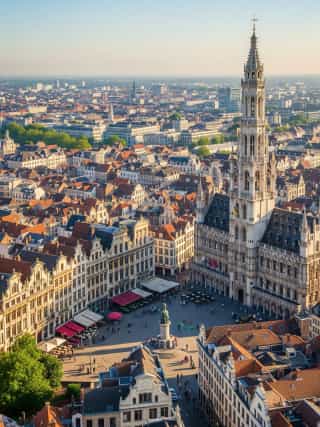
Brussels - The Capital of Belgium
- Population
- 1,218,255
- Language
- Dutch
- Continent
- Europe
- Since
- 979
- Eco Ranking
- 15/195
Source: Environmental Performance Index 2024.
About Brussels
Brussels has been the principal seat of Belgian government since the country's establishment as an independent state in 1830, when a revolution against Dutch rule led to Belgian independence and Brussels was designated the capital. The city's prominence extends well beyond Belgium: it serves as the de facto capital of the European Union, hosting the European Commission, the Council of the European Union, and the European Council, making it the primary center of EU executive and legislative coordination. The European Parliament formally sits in Strasbourg but holds committee work in Brussels. NATO's headquarters have been in Brussels since 1967. Belgium's domestic political structure is extraordinarily complex: a federal constitutional monarchy with three regions (Flemish, Walloon, and Brussels-Capital), three linguistic communities (Dutch, French, and German), and a political system in which linguistic division between Dutch-speaking Flanders and French-speaking Wallonia has repeatedly produced governmental crises. Belgium holds the world record for the longest period without a government, 541 days from 2010 to 2011. Brussels itself is officially bilingual (French and Dutch), though French predominates in daily use. The city is situated within the Flemish Region but governed separately as the Brussels-Capital Region.
About Belgium
Belgium is a federal constitutional monarchy divided into three regions (Flemish, Walloon, Brussels-Capital) and three linguistic communities. The political system is structured around linguistic communities to such a degree that most political parties operate exclusively in one language and do not run nationally. Coalition negotiations routinely take over a year, reflecting the difficulty of bridging regional and linguistic divides. Belgium is a founding member of both the EU and NATO.
View Brussels on the map
Flight time from Brussels to other capitals
| City | Distance (km) | Flight Time |
|---|---|---|
| London | 300 | 0h 21m |
| Paris | 300 | 0h 21m |
| Rome | 1200 | 1h 25m |
| Abu Dhabi | 5200 | 6h 7m |
| Washington, D.C. | 6200 | 7h 18m |
| Tokyo | 9400 | 11h 4m |
| Cape Town | 9500 | 11h 11m |
| Singapore | 10600 | 12h 28m |
| Buenos Aires | 11300 | 13h 18m |
| Canberra | 16700 | 19h 39m |
Capitals with similar population to Brussels
Capitals with similar eco ranking to Brussels
Source: Environmental Performance Index 2024.
Frequently Asked Questions
Why is Brussels the capital of Belgium?
Brussels became Belgium's capital when the country declared independence from the Netherlands in 1830. It was the center of the Belgian revolution and the largest city in the new state. The Provisional Government established in 1830 designated Brussels as the seat of national government, and it has remained so ever since.
Why is Brussels considered the capital of the European Union?
Brussels is the de facto capital of the EU because it hosts the European Commission (the EU's executive), the Council of the EU, and the European Council. The European Parliament's committees meet in Brussels, though its formal plenary sessions are held in Strasbourg under treaty obligation. Brussels was not formally designated the EU capital until the 1992 Edinburgh Agreement confirmed it as the principal seat of EU institutions.
What is Belgium's record for longest period without a government?
Belgium set a world record by going 541 days without a functioning federal government between 2010 and 2011, following elections that produced an irreconcilable division between Flemish and Francophone parties. A caretaker government managed affairs during this period. The country has also had other extended periods of governmental deadlock driven by its linguistic and regional divisions.
What language is spoken in Brussels?
Brussels is officially bilingual, both French and Dutch have official status in the Brussels-Capital Region. In practice, French is the predominant language of daily life for the majority of residents, while Dutch is the primary language of Flanders, which surrounds Brussels. A significant portion of the population also speaks English, partly due to the concentration of EU and NATO institutions.
When did NATO move its headquarters to Brussels?
NATO relocated its headquarters to Brussels in 1967, after France under President Charles de Gaulle withdrew from NATO's integrated military command structure and asked NATO to leave French territory. The headquarters was moved from Paris to a site near Brussels, initially in Evere, where it has remained. France rejoined NATO's integrated command structure in 2009.
Sights and landmarks
Climate and best time to visit
Regional significance
Culture and customs