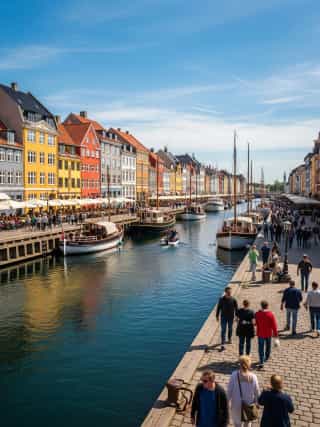
Copenhagen - The Capital of Denmark
- Population
- 658,390
- Language
- Danish
- Continent
- Europe
- Since
- 1443
- Eco Ranking
- 11/195
Source: Environmental Performance Index 2024.
About Copenhagen
Copenhagen became the capital of Denmark in 1443, when King Christopher of Bavaria transferred the royal residence there from Roskilde. The city had grown in political importance since the 14th century under Bishop Absalon, who fortified the site in 1167. It served as the seat of a Scandinavian superpower during the 17th century, when Denmark controlled the Øresund strait and extracted tolls from all ships passing between the North Sea and the Baltic, a revenue stream that financed the royal court and shaped the city's architecture. Denmark's political transformation from absolute monarchy to constitutional monarchy was formalized in the 1849 constitution, which established the Folketing (parliament). Today, Christiansborg Palace on the island of Slotsholmen houses all three branches of the Danish state simultaneously: the Folketing, the Supreme Court, and the Prime Minister's offices. The Danish monarch's official residence, Amalienborg Palace, is also in Copenhagen. Denmark is a unitary state, with the Faroe Islands and Greenland holding special autonomous status. Greenland's potential path to independence, debated since its 2009 autonomy expansion, makes Copenhagen's relationship to its autonomous territories an ongoing constitutional question.
About Denmark
Denmark is a constitutional monarchy with a unicameral parliament, the Folketing, consisting of 179 members, including two each from the Faroe Islands and Greenland. The monarch holds formal powers that are exercised in practice by the elected government. Denmark is a founding member of NATO and a member of the EU, though it has opt-outs on the euro, defense policy, and justice cooperation. The relationship between Copenhagen and the autonomous territories of Greenland and the Faroe Islands is governed by the Danish Realm (Rigsfællesskabet) framework.
View Copenhagen on the map
Flight time from Copenhagen to other capitals
| City | Distance (km) | Flight Time |
|---|---|---|
| London | 1000 | 1h 11m |
| Paris | 1000 | 1h 11m |
| Rome | 1500 | 1h 46m |
| Abu Dhabi | 4800 | 5h 39m |
| Washington, D.C. | 6500 | 7h 39m |
| Tokyo | 8700 | 10h 14m |
| Cape Town | 10000 | 11h 46m |
| Singapore | 10000 | 11h 46m |
| Buenos Aires | 12100 | 14h 14m |
| Canberra | 16000 | 18h 49m |
Capitals with similar population to Copenhagen
Capitals with similar eco ranking to Copenhagen
Source: Environmental Performance Index 2024.
Frequently Asked Questions
When did Copenhagen become Denmark's capital?
Copenhagen became the official capital of Denmark in 1443 when King Christopher of Bavaria moved the royal seat from Roskilde. However, the city had been a significant political and commercial center since the 12th century, when Bishop Absalon built a fortress on the site in 1167.
Where does the Danish parliament meet?
The Danish parliament, the Folketing, meets at Christiansborg Palace on the island of Slotsholmen in central Copenhagen. Christiansborg also houses the Supreme Court and the Prime Minister's offices, making it one of the few buildings in the world that serves as home to all three branches of government simultaneously.
Is Copenhagen the largest city in Denmark?
Yes, Copenhagen is the largest city in Denmark. The city proper has approximately 658,000 residents, while the Copenhagen metropolitan area, including the Swedish city of Malmö across the Øresund Bridge, is home to around 1.4 million people on the Danish side.
Does Denmark control Greenland, and could Greenland become independent?
Greenland is an autonomous territory within the Danish Realm. It gained home rule in 1979 and expanded autonomy in 2009, which included the right to declare independence through a referendum. Independence discussions have been ongoing, and Greenland controls its own domestic affairs, though Denmark remains responsible for foreign policy and defense.
What was Denmark's historical strategic importance in the Øresund?
From 1429 until 1857, Denmark charged the Sound Dues, tolls levied on all ships passing through the Øresund strait between the North Sea and the Baltic Sea. At its peak, these tolls accounted for two-thirds of Danish state revenue, making control of Copenhagen and the strait one of the most lucrative geopolitical assets in northern Europe.
Sights and landmarks
Climate and best time to visit
Regional significance
Culture and customs