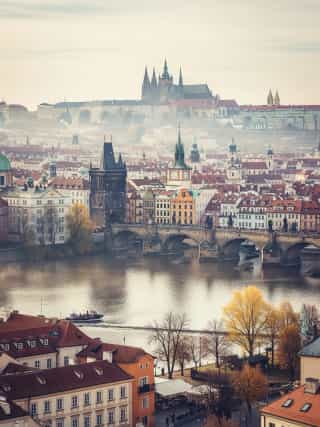
Prague - The Capital of Czech Republic
- Population
- 1,335,084
- Language
- Czech
- Continent
- Europe
- Since
- 1918
- Eco Ranking
- 17/195
Source: Environmental Performance Index 2024.
About Prague
Prague's role as a political capital spans more than a millennium. It served as the seat of the Kingdom of Bohemia, one of the most significant polities in the Holy Roman Empire, and reached its peak as an imperial capital under Holy Roman Emperor Charles IV in the 14th century, when it was among Europe's largest cities. The city was the focal point of the Hussite reforms of the 15th century and, centuries later, of the Defenestration of Prague in 1618, which triggered the Thirty Years' War. Prague became the capital of Czechoslovakia in 1918 following the collapse of the Austro-Hungarian Empire, with Tomáš Masaryk as the first president. The country was occupied by Nazi Germany from 1939 to 1945. Communist rule, imposed after the 1948 coup, lasted until the Velvet Revolution of November 1989, a largely non-violent popular uprising that ended single-party communist governance. On January 1, 1993, Czechoslovakia dissolved peacefully into two successor states, the Velvet Divorce, and Prague became the capital of the Czech Republic, renamed Czechia in 2016. Prague is home to the Chamber of Deputies, the Senate, and Prague Castle, the official seat of the president. The Czech Republic has been a NATO member since 1999 and an EU member since 2004.
About Czech Republic
The Czech Republic is a parliamentary democracy and republic. The bicameral Parliament consists of the Chamber of Deputies and the Senate. The president is directly elected and holds limited but significant powers, particularly in foreign and judicial appointments. The Czech Republic joined NATO in 1999 and the EU in 2004, and has been among Central Europe's most economically developed states since the democratic transition.
View Prague on the map
Flight time from Prague to other capitals
| City | Distance (km) | Flight Time |
|---|---|---|
| Paris | 900 | 1h 4m |
| Rome | 900 | 1h 4m |
| London | 1000 | 1h 11m |
| Abu Dhabi | 4500 | 5h 18m |
| Washington, D.C. | 6900 | 8h 7m |
| Tokyo | 9100 | 10h 42m |
| Cape Town | 9300 | 10h 56m |
| Singapore | 9800 | 11h 32m |
| Buenos Aires | 11800 | 13h 53m |
| Canberra | 16000 | 18h 49m |
Capitals with similar population to Prague
| City | Population |
|---|---|
| Sofia | 1,405,612 |
| Belgrade | 1,405,192 |
| Dublin | 1,388,233 |
| Montevideo | 1,381,611 |
| Tegucigalpa | 1,363,000 |
| Prague | 1,335,084 |
| Niamey | 1,292,023 |
Capitals with similar eco ranking to Prague
Source: Environmental Performance Index 2024.
Frequently Asked Questions
When did Prague become the capital of the Czech Republic?
Prague became the capital of the independent Czech Republic on January 1, 1993, when Czechoslovakia dissolved peacefully into the Czech Republic and Slovakia. Before that, Prague had been the capital of Czechoslovakia since its formation in 1918 after the collapse of the Austro-Hungarian Empire.
What was the Velvet Revolution?
The Velvet Revolution was a largely non-violent popular uprising in Czechoslovakia in November 1989 that ended over 40 years of communist rule. Massive street protests, particularly in Prague's Wenceslas Square, forced the Communist Party to relinquish its monopoly on power. Playwright and dissident Václav Havel became the first post-communist president.
What was the Velvet Divorce?
The Velvet Divorce refers to the peaceful dissolution of Czechoslovakia into two separate states, the Czech Republic and Slovakia, on January 1, 1993. Unlike many national separations, it was negotiated politically without conflict or referendum. The name echoes the Velvet Revolution that preceded it.
Why is Prague historically significant beyond being a national capital?
Prague was an imperial capital of the Holy Roman Empire under Charles IV in the 14th century, when it ranked among Europe's most prominent cities. It was the center of the Hussite religious reform movement, the trigger point for the Thirty Years' War (the Defenestration of Prague in 1618), and a major intellectual capital during the Habsburg era.
Is Prague a member of the European Union?
The Czech Republic, of which Prague is the capital, joined the European Union on May 1, 2004, as part of the bloc's largest enlargement. The country uses the Czech koruna and has not adopted the euro, a subject of ongoing political debate.
Sights and landmarks
Climate and best time to visit
Culture and customs
Economy