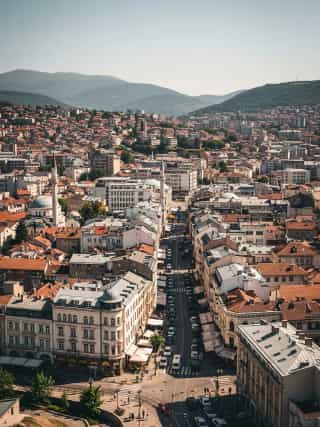
Sarajevo - The Capital of Bosnia and Herzegovina
- Population
- 395,133
- Language
- Bosnian
- Continent
- Europe
- Since
- 1461
- Eco Ranking
- 90/195
Source: Environmental Performance Index 2024.
About Sarajevo
Sarajevo was founded as an Ottoman city in 1461 under Isa-Beg Ishaković and served as the capital of the Ottoman province of Bosnia for over four centuries. On 28 June 1914, Archduke Franz Ferdinand of Austria-Hungary was assassinated on the city's Latin Bridge by Gavrilo Princip, an event that directly triggered the outbreak of World War I. During the Bosnian War (1992-1995), Sarajevo endured the longest siege of a capital city in modern warfare: 1,425 days, during which Bosnian Serb forces surrounded the city and an estimated 13,000 people were killed. The Dayton Agreement, signed in November 1995, ended the war and established Bosnia and Herzegovina's complex constitutional structure: two entities (the Federation of BiH and Republika Srpska), a three-member rotating presidency representing the three constituent peoples (Bosniaks, Serbs, and Croats), and an internationally appointed High Representative with executive powers. Sarajevo serves as the capital of the whole state and of the Federation entity.
About Bosnia and Herzegovina
Bosnia and Herzegovina is a parliamentary republic with a governmental structure established by the Dayton Agreement of 1995. Two entities, the Federation of BiH and Republika Srpska, exercise substantial autonomy. The state-level presidency has three members who rotate the chairmanship every eight months. The Office of the High Representative retains the authority to impose laws and remove officials, making Bosnia one of the few countries with a form of international executive oversight.
View Sarajevo on the map
Flight time from Sarajevo to other capitals
| City | Distance (km) | Flight Time |
|---|---|---|
| Rome | 500 | 0h 35m |
| Paris | 1300 | 1h 32m |
| London | 1600 | 1h 53m |
| Abu Dhabi | 3900 | 4h 35m |
| Washington, D.C. | 7500 | 8h 49m |
| Cape Town | 8600 | 10h 7m |
| Tokyo | 9400 | 11h 4m |
| Singapore | 9500 | 11h 11m |
| Buenos Aires | 11700 | 13h 46m |
| Canberra | 15800 | 18h 35m |
Capitals with similar population to Sarajevo
| City | Population |
|---|---|
| Bratislava | 432,864 |
| Canberra | 431,380 |
| Windhoek | 431,000 |
| Tirana | 418,495 |
| Dodoma | 410,956 |
| Sarajevo | 395,133 |
| Port Moresby | 383,000 |
Capitals with similar eco ranking to Sarajevo
Source: Environmental Performance Index 2024.
Frequently Asked Questions
Why is Sarajevo historically significant?
Sarajevo was the site of the assassination of Archduke Franz Ferdinand of Austria-Hungary on 28 June 1914, which directly triggered World War I. The assassination, carried out by Gavrilo Princip of the Black Hand society, led Austria-Hungary to issue an ultimatum to Serbia, setting off the chain of alliance activations that drew the major European powers into war within weeks.
How long was the Siege of Sarajevo?
The Siege of Sarajevo lasted 1,425 days, from April 1992 to February 1996, the longest siege of a capital city in the history of modern warfare, surpassing the Siege of Leningrad during World War II. Bosnian Serb forces surrounded the city, cutting off supplies and conducting systematic sniper and artillery attacks on civilians. An estimated 13,000 people were killed during the siege.
What is Bosnia and Herzegovina's system of government?
Bosnia and Herzegovina has a highly complex system established by the Dayton Agreement of 1995. The state has a three-member presidency (one Bosniak, one Croat, one Serb) with a rotating chairmanship every eight months. The country is divided into two entities, the Federation of BiH and Republika Srpska, which have significant autonomous powers. An internationally appointed High Representative can impose laws and remove elected officials.
When did Bosnia and Herzegovina become an independent state?
Bosnia and Herzegovina declared independence from Yugoslavia on 1 March 1992, following a referendum boycotted by Bosnian Serbs. The declaration was recognised by the European Community and the United States in April 1992. Independence was immediately followed by war as Bosnian Serb forces, backed by the Federal Republic of Yugoslavia, launched military operations against the new state.
Is Sarajevo the capital of both entities in Bosnia and Herzegovina?
Sarajevo is the capital of Bosnia and Herzegovina as a whole and the capital of the Federation of BiH entity. Republika Srpska, the other entity, has its capital in Banja Luka, located in the northwest of the country. This divided structure reflects the ethnic and political partition embedded in the Dayton Agreement.
Sights and landmarks
Climate and best time to visit
Regional significance
Culture and customs
Economy