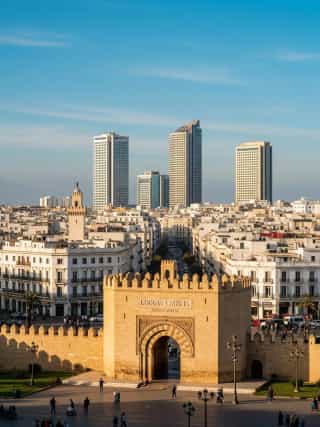
Tunis - The Capital of Tunisia
- Population
- 2,291,352
- Language
- Arabic
- Continent
- Africa
- Since
- 1956
- Eco Ranking
- 93/195
Source: Environmental Performance Index 2024.
About Tunis
Tunis became the capital of independent Tunisia in 1956 when the country gained independence from France after decades of French protectorate rule. The city has been the dominant urban and administrative centre of the region for centuries, it stands near the ruins of ancient Carthage, the Phoenician city that rivalled Rome for control of the western Mediterranean. Under the French protectorate established in 1881, Tunis served as the colonial capital. Tunis became internationally prominent when Tunisia's Jasmine Revolution of December 2010 - January 2011 triggered the wider Arab Spring. The self-immolation of street vendor Mohamed Bouazizi in Sidi Bouzid sparked protests that spread to Tunis, ultimately forcing President Zine El Abidine Ben Ali, who had ruled for 23 years, to flee to Saudi Arabia in January 2011. Tunisia was initially regarded as the Arab Spring's only democratic success story: a new constitution was adopted in 2014, and several free elections were held. This democratic transition ended on 25 July 2021, when President Kais Saied suspended parliament, dismissed the prime minister, and assumed emergency powers, later adopting a new constitution in 2022 that significantly concentrated power in the presidency. The European Parliament and numerous governments condemned the measures as a democratic backslide. Tunis houses all branches of government, including the presidency, parliament, and the Constitutional Court.
About Tunisia
Tunisia is a presidential republic in which Kais Saied, elected in 2019, has consolidated significant executive authority following his 2021 assumption of emergency powers and a 2022 constitutional revision. The country has a predominantly Arab and Berber Muslim population of approximately 12 million. Tunisia borders Algeria and Libya and has a significant relationship with the European Union, serving as a key transit country for migration across the Mediterranean.
View Tunis on the map
Flight time from Tunis to other capitals
| City | Distance (km) | Flight Time |
|---|---|---|
| Rome | 600 | 0h 42m |
| Paris | 1500 | 1h 46m |
| London | 1800 | 2h 7m |
| Abu Dhabi | 4400 | 5h 11m |
| Washington, D.C. | 7300 | 8h 35m |
| Cape Town | 7900 | 9h 18m |
| Singapore | 10200 | 12h 0m |
| Tokyo | 10400 | 12h 14m |
| Buenos Aires | 10600 | 12h 28m |
| Canberra | 16300 | 19h 11m |
Capitals with similar population to Tunis
Capitals with similar eco ranking to Tunis
Source: Environmental Performance Index 2024.
Frequently Asked Questions
What was the Jasmine Revolution?
The Jasmine Revolution was the Tunisian popular uprising of December 2010 - January 2011 that ended the 23-year rule of President Zine El Abidine Ben Ali. It was sparked by the self-immolation of Mohamed Bouazizi, a street vendor whose cart had been confiscated. Mass protests in Tunis and other cities forced Ben Ali to flee to Saudi Arabia on 14 January 2011. The revolution became the catalyst for the broader Arab Spring across the Middle East and North Africa.
Why is Tunisia considered the Arab Spring's only success story?
Tunisia was the only country of the Arab Spring uprisings to successfully transition to democracy, at least temporarily. A new democratic constitution was adopted in January 2014, regarded as one of the most progressive in the Arab world. Multiple free elections were held, and power transferred peacefully between parties. Other Arab Spring countries, including Egypt, Libya, and Syria, either reverted to authoritarianism or descended into prolonged conflict.
What happened to Tunisia's democracy in 2021?
On 25 July 2021, President Kais Saied suspended parliament, dismissed the prime minister, and assumed emergency rule, citing governmental dysfunction and a COVID-19 crisis. He subsequently governed by decree, dissolved the Independent High Authority for Elections, and oversaw the adoption of a new constitution in 2022 that concentrated executive power in the presidency and weakened parliament. Critics described the events as a constitutional coup.
When did Tunis become the capital of Tunisia?
Tunis became the capital of independent Tunisia on 20 March 1956, when the country gained independence from France. It had served as the capital of the French Protectorate of Tunisia since 1881. Tunis was also the capital of the Husseinid dynasty that nominally governed Tunisia under Ottoman suzerainty before French control.
Is Tunis the largest city in Tunisia?
Yes. Tunis is the largest city in Tunisia, with a metropolitan area population of approximately 2.3 million, roughly 20% of the country's total population. It is the country's political, economic, and cultural centre. The greater Tunis metropolitan area includes several municipalities that together form the dominant urban cluster of northern Tunisia.
Sights and landmarks
Climate and best time to visit
Regional significance
Economy