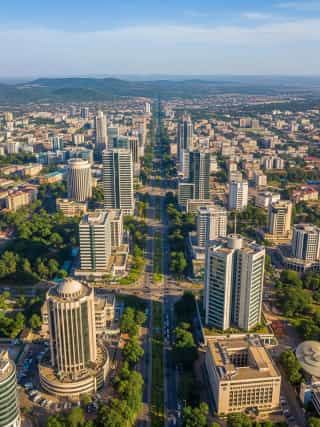
Abuja - The Capital of Nigeria
- Population
- 3,464,000
- Language
- English
- Continent
- Africa
- Since
- 1991
- Eco Ranking
- 140/195
Source: Environmental Performance Index 2024.
About Abuja
Abuja became Nigeria's federal capital on 12 December 1991, replacing Lagos after decades of debate about the dominance of a coastal, Yoruba-associated city over a deeply multi-ethnic nation. The decision to relocate the capital had been made as early as 1976 under the military government of Murtala Mohammed, who identified the need for a geographically and ethnically neutral seat of government. Abuja was purpose-built in the geographic center of the country, in the Federal Capital Territory, which was carved out of land belonging to three states. Its central location was intended to be equidistant from Nigeria's major regional and ethnic blocs: the predominantly Muslim north, the largely Christian south, and the Niger Delta. The city hosts the National Assembly, the Supreme Court, the Presidential Villa (Aso Rock), and the headquarters of the Economic Community of West African States (ECOWAS). Construction began in earnest in the late 1970s and the federal government completed its phased relocation by 1991. Abuja has grown far beyond its planned population projections.
About Nigeria
Nigeria is a federal presidential republic composed of 36 states and the Federal Capital Territory. It operates under a constitution modeled partly on the United States system, with a bicameral National Assembly. Nigeria is the most populous country in Africa, with over 220 million people spread across more than 250 ethnic groups. The capital relocation from Lagos to Abuja was a deliberate political act to prevent any single region from claiming symbolic ownership of the national government.
View Abuja on the map
Flight time from Abuja to other capitals
| City | Distance (km) | Flight Time |
|---|---|---|
| Rome | 3700 | 4h 21m |
| Paris | 4400 | 5h 11m |
| London | 4800 | 5h 39m |
| Cape Town | 4900 | 5h 46m |
| Abu Dhabi | 5300 | 6h 14m |
| Buenos Aires | 8400 | 9h 53m |
| Washington, D.C. | 8900 | 10h 28m |
| Singapore | 10700 | 12h 35m |
| Tokyo | 13000 | 15h 18m |
| Canberra | 15200 | 17h 53m |
Capitals with similar population to Abuja
| City | Population |
|---|---|
| Dakar | 3,732,284 |
| Berlin | 3,669,491 |
| Abuja | 3,464,000 |
| Addis Ababa | 3,352,000 |
| Santo Domingo | 3,339,410 |
| Pyongyang | 3,255,288 |
| Asunción | 3,222,000 |
Capitals with similar eco ranking to Abuja
| City | Eco Rank |
|---|---|
| Malé | 137 |
| Praia | 138 |
| Abuja | 140 |
| Porto-Novo | 141 |
| Ulaanbaatar | 142 |
| Banjul | 143 |
| Accra | 144 |
Source: Environmental Performance Index 2024.
Frequently Asked Questions
Why did Nigeria move its capital from Lagos to Abuja?
Lagos was seen as too closely associated with the Yoruba ethnic group and the southwestern region, creating symbolic imbalances in a country with over 250 ethnic groups. The government chose a central, neutral location to reduce ethno-regional tensions. The decision was first announced in 1976 under military head of state Murtala Mohammed.
When did Abuja officially become Nigeria's capital?
The Federal Capital Territory was established in 1976, but the full transfer of capital functions from Lagos was completed on 12 December 1991. Some federal institutions had begun relocating gradually through the 1980s before the formal handover.
Is Abuja the largest city in Nigeria?
No. Lagos remains Nigeria's largest city by a wide margin, with an estimated population of over 15 million in the metropolitan area. Abuja is a planned city that has grown rapidly but has not matched Lagos in population or economic output.
What major institutions are headquartered in Abuja?
Abuja is home to Nigeria's National Assembly, Supreme Court, and the Presidential Villa (Aso Rock). It also hosts the headquarters of ECOWAS, the Economic Community of West African States, making it a significant seat of regional governance.
Was Abuja always a planned city?
Yes. Abuja was designed from scratch following a 1976 government decree. International planning firms were commissioned to design the city layout, and construction began in the late 1970s. It replaced largely uninhabited and rural land in the geographic center of Nigeria.
Sights and landmarks
Climate and best time to visit
Regional significance
Economy