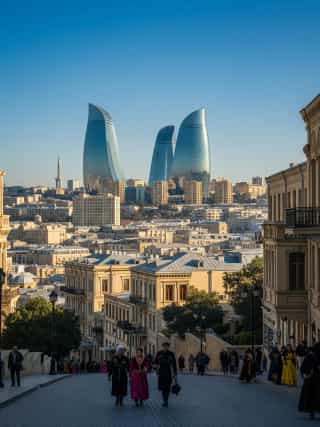
Baku - The Capital of Azerbaijan
- Population
- 2,293,600
- Language
- Azerbaijani
- Continent
- Asia
- Since
- 885
- Eco Ranking
- 121/195
Source: Environmental Performance Index 2024.
About Baku
Baku has been a seat of political authority in the South Caucasus since at least the 9th century, when it served as the capital of the Shirvanshah dynasty. The city's strategic position on the Caspian Sea and its proximity to oil-rich lands have shaped its political history for over a millennium. Baku was incorporated into the Russian Empire in 1806 and became the center of the world's first major oil industry in the late 19th century. In 1918, following the collapse of the Russian Empire, the Azerbaijan Democratic Republic was proclaimed in Baku, the first democratic secular republic in the Muslim world. Soviet forces took the city in 1920, incorporating it into the USSR as the capital of the Azerbaijan Soviet Socialist Republic. Baku became the capital of independent Azerbaijan again in 1991, when the Soviet Union dissolved. The Nagorno-Karabakh conflict, a dispute over the enclave populated largely by ethnic Armenians but within Azerbaijani Soviet boundaries, has defined Azerbaijani politics since the late 1980s. Azerbaijan's military victory in the 2020 Karabakh War and the 2023 offensive resolved the territorial dispute in its favor. Baku houses the Milli Majlis (National Assembly), the Presidential Administration, and the State Oil Company of Azerbaijan (SOCAR).
About Azerbaijan
Azerbaijan is a presidential republic in which President Ilham Aliyev, who has held power since 2003, exercises dominant authority. The Aliyev family has governed Azerbaijan since 1993, when Ilham's father Heydar Aliyev took power. Azerbaijan is a major Caspian oil and gas producer. International observers have consistently found Azerbaijani elections to fall short of democratic standards. The country fought and won two wars with Armenia over Nagorno-Karabakh, in 1994 and 2020/2023.
View Baku on the map
Flight time from Baku to other capitals
| City | Distance (km) | Flight Time |
|---|---|---|
| Abu Dhabi | 1800 | 2h 7m |
| Rome | 3100 | 3h 39m |
| Paris | 3800 | 4h 28m |
| London | 4000 | 4h 42m |
| Singapore | 6900 | 8h 7m |
| Tokyo | 7500 | 8h 49m |
| Cape Town | 8900 | 10h 28m |
| Washington, D.C. | 9700 | 11h 25m |
| Canberra | 13200 | 15h 32m |
| Buenos Aires | 13800 | 16h 14m |
Capitals with similar population to Baku
Capitals with similar eco ranking to Baku
| City | Eco Rank |
|---|---|
| Kuala Lumpur | 118 |
| Palikir | 119 |
| Ashgabat | 120 |
| Baku | 121 |
| Nuku'alofa | 123 |
| Luanda | 124 |
| Tegucigalpa | 124 |
Source: Environmental Performance Index 2024.
Frequently Asked Questions
How long has Baku been a capital city?
Baku has served as a political capital since at least the 9th century, when it was the seat of the Shirvanshah dynasty. It later became the capital of the Azerbaijan Democratic Republic in 1918, the Azerbaijan Soviet Socialist Republic in 1920, and independent Azerbaijan in 1991.
What was the Azerbaijan Democratic Republic?
The Azerbaijan Democratic Republic (1918-1920) was the first modern democratic republic in the Muslim world, established after the collapse of the Russian Empire. Based in Baku, it granted women the right to vote, preceding many European countries. It was occupied and absorbed by Soviet forces in April 1920.
When did Baku become the capital of independent Azerbaijan?
Baku became the capital of independent Azerbaijan on 30 August 1991, when Azerbaijan declared independence from the Soviet Union, formalized on 18 October 1991. Baku had already served as the capital of Soviet Azerbaijan since 1920.
Is Baku the largest city in Azerbaijan?
Yes. Baku is the largest city in Azerbaijan by a wide margin, with approximately 2.3 million residents in the city and over 3 million in the greater metropolitan area. The capital contains roughly 30% of Azerbaijan's total population.
How has the Nagorno-Karabakh conflict affected Baku?
The Nagorno-Karabakh conflict has been central to Azerbaijani politics since ethnic tensions erupted in the late Soviet period. Baku was the scene of anti-Armenian pogroms in 1990 and of mass demonstrations demanding Karabakh's return. Azerbaijan's victories in the 2020 war and the 2023 offensive, which ended Armenian governance of the enclave, were celebrated as major national achievements by the government in Baku.
Sights and landmarks
Climate and best time to visit
Economy