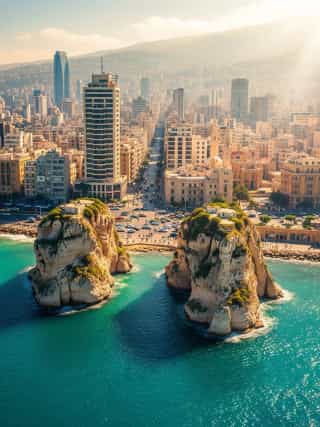
Beirut - The Capital of Lebanon
- Population
- 2,407,000
- Language
- Arabic
- Continent
- Asia
- Since
- 1943
- Eco Ranking
- 128/195
Source: Environmental Performance Index 2024.
About Beirut
Beirut became the capital of an independent Lebanese state in 1943, when Lebanon gained independence from the French Mandate that had been established after World War I under League of Nations authorization. The French had administered Lebanon separately from Syria, and Beirut had been the administrative center of the mandate. In the decades after independence, Beirut developed into a regional financial and press center, often called the 'Paris of the Middle East' in that era, a description that captured its role as a relatively open city in a restrictive region. That period ended with the civil war of 1975-1990, which killed an estimated 150,000 people, physically divided the city along the 'Green Line,' and left state institutions severely weakened. The political system established after the war under the Taif Agreement allocates government positions along sectarian lines: the President must be Maronite Christian, the Prime Minister Sunni Muslim, and the Speaker of Parliament Shia Muslim. On 4 August 2020, an explosion at Beirut's port, caused by 2,750 tonnes of improperly stored ammonium nitrate, killed over 200 people, injured 6,000, and destroyed much of the city center, further destabilizing a government already in fiscal collapse.
About Lebanon
Lebanon is a parliamentary republic with a confessional political system, in which top government positions are distributed by religious community under the 1943 National Pact and 1989 Taif Agreement. This structure has produced chronic political deadlock, most notably a 29-month presidential vacancy between 2022 and 2025. Hezbollah, designated a terrorist organization by several states, operates as both a political party and an armed force with significant influence over Lebanese governance.
View Beirut on the map
Flight time from Beirut to other capitals
| City | Distance (km) | Flight Time |
|---|---|---|
| Abu Dhabi | 2100 | 2h 28m |
| Rome | 2200 | 2h 35m |
| Paris | 3200 | 3h 46m |
| London | 3500 | 4h 7m |
| Cape Town | 7700 | 9h 4m |
| Singapore | 7900 | 9h 18m |
| Tokyo | 9000 | 10h 35m |
| Washington, D.C. | 9400 | 11h 4m |
| Buenos Aires | 12400 | 14h 35m |
| Canberra | 14100 | 16h 35m |
Capitals with similar population to Beirut
Capitals with similar eco ranking to Beirut
Source: Environmental Performance Index 2024.
Frequently Asked Questions
When did Beirut become the capital of Lebanon?
Beirut became the capital of independent Lebanon in 1943, when the country achieved independence from the French Mandate. France had controlled Lebanon under a League of Nations mandate since 1920, and Beirut had served as the administrative center throughout that period.
What caused the 2020 Beirut explosion?
On 4 August 2020, approximately 2,750 tonnes of ammonium nitrate that had been stored unsafely in a warehouse at the Port of Beirut detonated, causing one of the largest non-nuclear explosions in history. The blast killed over 200 people, injured around 6,000, and left an estimated 300,000 people homeless. Negligence and institutional failure at multiple levels of government contributed to the disaster.
How does Lebanon's confessional system affect Beirut's government?
Lebanon's confessional system, codified in the 1943 National Pact and amended by the 1989 Taif Agreement, reserves the presidency for a Maronite Christian, the premiership for a Sunni Muslim, and the speakership of parliament for a Shia Muslim. This arrangement was designed to balance Lebanon's religious communities but has frequently produced political paralysis, including a 29-month presidential vacancy that ended in 2025.
Was Beirut damaged during the Lebanese Civil War?
Yes. The civil war, which lasted from 1975 to 1990, caused massive destruction in Beirut. The city was divided along a line of demarcation called the Green Line, separating predominantly Christian East Beirut from predominantly Muslim West Beirut. An estimated 150,000 people died in the conflict nationwide, and Beirut's urban fabric was severely damaged.
Is Beirut the largest city in Lebanon?
Yes. Beirut is the largest city in Lebanon, though its city-proper population is relatively modest at around 361,000. The Greater Beirut area, including suburbs, is estimated at over 2.4 million, representing more than a third of Lebanon's total population concentrated in and around the capital.
Sights and landmarks
Regional significance
Culture and customs