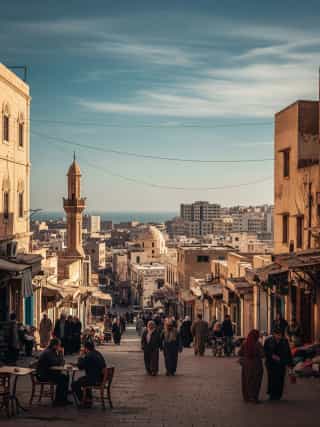
Tripoli - The Capital of Libya
- Population
- 1,165,000
- Language
- Arabic
- Continent
- Africa
- Since
- 1951
- Eco Ranking
- -
Source: Environmental Performance Index 2024.
About Tripoli
Tripoli has been Libya's capital since the country gained independence in 1951, serving as the seat of power through the monarchy of King Idris and then the 42-year regime of Muammar Gaddafi, who seized power in a military coup in 1969. Under Gaddafi, Tripoli was the administrative centre of a state defined by its leader's erratic governance, pan-Arab ideology, and significant oil revenues. Gaddafi formally abolished conventional government structures in favour of a 'Jamahiriya', a state of the masses, while in practice ruling as an absolute dictator. The 2011 Arab Spring triggered a civil conflict in Libya that became a NATO-backed military intervention. Gaddafi was killed by rebel forces in October 2011, and Libya entered a period of sustained fragmentation. The country has since been divided between competing armed factions and rival governments. Since 2014, Libya has effectively operated with two distinct governmental authorities: a UN-recognised Government of National Unity (GNU) based in Tripoli, and a rival administration in the east (based in Tobruk and Benghazi) backed by the Libyan National Army of General Khalifa Haftar. In 2019-2020, Haftar's forces besieged Tripoli for over a year before being repelled. This ongoing division makes Tripoli's status as an effective capital contested in practice, it governs the west of the country but not the east. Libya holds the largest proven oil reserves in Africa.
About Libya
Libya is nominally a unitary state but has been functionally divided since 2014. The UN-recognised government sits in Tripoli, while a rival administration backed by the Libyan National Army controls the east. The country has no functioning central bank that both factions recognise and has been a major transit point for migration from sub-Saharan Africa to Europe. Libya's oil wealth, managed separately by the competing factions, has fuelled rather than resolved the conflict.
View Tripoli on the map
Flight time from Tripoli to other capitals
| City | Distance (km) | Flight Time |
|---|---|---|
| Rome | 1000 | 1h 11m |
| Paris | 2000 | 2h 21m |
| London | 2300 | 2h 42m |
| Abu Dhabi | 4100 | 4h 49m |
| Cape Town | 7400 | 8h 42m |
| Washington, D.C. | 7800 | 9h 11m |
| Singapore | 10000 | 11h 46m |
| Tokyo | 10600 | 12h 28m |
| Buenos Aires | 10600 | 12h 28m |
| Canberra | 16000 | 18h 49m |
Capitals with similar population to Tripoli
Frequently Asked Questions
Why does Libya have two governments?
Following the 2011 civil war and the killing of Gaddafi, Libya failed to establish a stable unified government. A 2014 election was contested, leading to the emergence of rival parliaments and armed factions. Since then, an internationally recognised government has operated from Tripoli while a rival administration backed by General Khalifa Haftar's Libyan National Army controls the east. Multiple reconciliation efforts have failed to reunify the country.
When did Tripoli become Libya's capital?
Tripoli became the capital of the independent Kingdom of Libya in 1951, when the country gained independence under King Idris with UN support. Under the monarchy, Libya initially had two capitals, Tripoli and Benghazi, sharing governmental functions. After Gaddafi's 1969 coup, Tripoli became the uncontested seat of government.
What was Gaddafi's Jamahiriya?
Gaddafi introduced the concept of the Jamahiriya, 'state of the masses', in 1977, abolishing conventional government structures and replacing them with a system of People's Committees and Congresses theoretically governed by direct democracy. In practice, Gaddafi retained absolute power. The system was outlined in his 'Green Book.' The formal name of the state became the Great Socialist People's Libyan Arab Jamahiriya.
What role did NATO play in the 2011 Libyan civil war?
NATO conducted a military intervention in Libya from March to October 2011, authorised by UN Security Council Resolution 1973 to protect civilians. NATO enforced a no-fly zone and conducted airstrikes against Gaddafi's forces, preventing a potential massacre in Benghazi and ultimately tipping the balance toward rebel forces. Gaddafi was captured and killed by rebels in Sirte on 20 October 2011.
Who is Khalifa Haftar?
Khalifa Haftar is a Libyan military commander who leads the Libyan National Army (LNA), the dominant armed force in eastern Libya. A former Gaddafi-era general who later worked with the CIA, Haftar launched a military campaign in 2014 against Islamist militias and subsequently expanded his control over eastern and southern Libya. His forces besieged Tripoli from 2019 to 2020 without success. He is backed primarily by Egypt, the UAE, and Russia.
Sights and landmarks
Climate and best time to visit
Regional significance