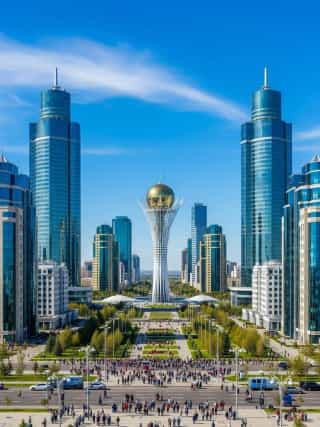
Astana - The Capital of Kazakhstan
- Population
- 1,184,469
- Language
- Kazakh
- Continent
- Asia
- Since
- 1997
- Eco Ranking
- 77/195
Source: Environmental Performance Index 2024.
About Astana
Astana became Kazakhstan's capital in 1997 by presidential decree of Nursultan Nazarbayev, replacing the former capital Almaty. The stated reasons included Almaty's vulnerability to earthquakes, its southern location near the Kyrgyz border, and insufficient space for expansion. Critics noted that Astana's geographic centrality and position in the Russophone north, closer to Russia's border, also served to project Kazakhstani sovereignty over a region with a significant ethnic Russian population. Nazarbayev commissioned spectacular futuristic architecture for the new capital, designed partly by Norman Foster and other international firms, in what many observers characterized as an exercise in authoritarian nation-branding. In 2019, Astana was renamed Nur-Sultan in honor of the then-president, who had resigned but retained sweeping formal powers. Following Nazarbayev's fall from political favor amid mass protests in January 2022, the city was renamed back to Astana in September 2022 under his successor Kassym-Jomart Tokayev. The capital hosts the Parliament, the presidency, and the Supreme Court. Almaty remains Kazakhstan's largest city and commercial center.
About Kazakhstan
Kazakhstan is a presidential republic in which the president holds dominant executive authority. The country has been governed by two presidents since independence in 1991: Nursultan Nazarbayev, who ruled until 2019, and Kassym-Jomart Tokayev, who assumed the presidency that year. Kazakhstan is the world's largest landlocked country and a major producer of oil, gas, and uranium. It maintains close ties with both Russia and China while pursuing a multi-vector foreign policy.
View Astana on the map
Flight time from Astana to other capitals
| City | Distance (km) | Flight Time |
|---|---|---|
| Abu Dhabi | 3300 | 3h 53m |
| Rome | 4500 | 5h 18m |
| London | 4800 | 5h 39m |
| Paris | 4800 | 5h 39m |
| Tokyo | 5600 | 6h 35m |
| Singapore | 6300 | 7h 25m |
| Washington, D.C. | 9500 | 11h 11m |
| Cape Town | 10800 | 12h 42m |
| Canberra | 12200 | 14h 21m |
| Buenos Aires | 15600 | 18h 21m |
Capitals with similar population to Astana
Capitals with similar eco ranking to Astana
Source: Environmental Performance Index 2024.
Frequently Asked Questions
Why did Kazakhstan move its capital from Almaty to Astana?
President Nazarbayev announced the capital transfer in 1994 and implemented it in 1997. Official reasons included Almaty's seismic risk, limited expansion space, and its peripheral southern location. Strategic motivations included asserting Kazakhstani state presence in the northern, more ethnically Russian regions of the country and building a showcase capital as a symbol of national ambition.
Why was Astana renamed Nur-Sultan and then back to Astana?
In March 2019, Nazarbayev resigned as president and the parliament renamed the city Nur-Sultan in his honor. After mass anti-government protests in January 2022 revealed the extent of Nazarbayev's diminished political support, his successor Tokayev moved to reduce his influence. In September 2022, the city's name was reverted to Astana.
When did Astana officially become Kazakhstan's capital?
Astana officially became Kazakhstan's capital on 10 December 1997, when the government formally relocated from Almaty. The city was then known as Akmola; it was renamed Astana (meaning 'capital' in Kazakh) in 1998.
Is Astana the largest city in Kazakhstan?
No. Almaty remains Kazakhstan's largest city, with approximately 2 million residents. Astana has grown rapidly since becoming the capital, reaching around 1.2 million, but it has not overtaken Almaty in population or economic activity.
Who designed Astana's government buildings?
Astana's futuristic government district was designed by a range of international architects. British architect Norman Foster designed the Khan Shatyr entertainment center and the Palace of Peace and Reconciliation pyramid. Japanese architect Kisho Kurokawa designed the city's master plan. The projects were central to Nazarbayev's effort to build a globally recognizable capital.
Sights and landmarks
Climate and best time to visit
Economy