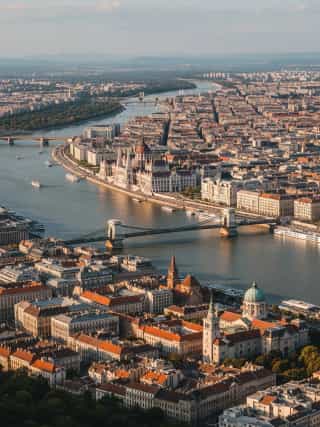
Budapest - The Capital of Hungary
- Population
- 1,752,286
- Language
- Hungarian
- Continent
- Europe
- Since
- 1873
- Eco Ranking
- 31/195
Source: Environmental Performance Index 2024.
About Budapest
Budapest came into existence as a single city only on 17 November 1873, when the three separate municipalities of Buda, Óbuda, and Pest were merged by act of the Hungarian Diet. The unification was a deliberate political act of national assertion, creating a capital city capable of serving the ambitions of Hungary within the Austro-Hungarian Compromise of 1867, which had re-established Hungary as a co-equal partner in the Habsburg Empire. Budapest served as one of the two capitals of the dual monarchy, Vienna the other, until the empire's collapse at the end of World War I. The city was the focal point of the Hungarian Revolution of 1956, when a popular uprising against Soviet-imposed rule was suppressed by Soviet military intervention after two weeks of fighting that killed thousands of Hungarians. An estimated 200,000 Hungarians fled the country as refugees. After 1990, Budapest became the capital of a democratic Hungary and the seat of EU and NATO membership. The Hungarian Parliament building on the Danube, completed in 1902, is one of the largest parliament buildings in the world at 17,745 square meters of floor space. Hungary has been governed by Prime Minister Viktor Orbán and his Fidesz party since 2010, with significant controversy over democratic backsliding.
About Hungary
Hungary is a parliamentary republic governed under a 2011 constitution enacted by the Fidesz supermajority government. Prime Minister Viktor Orbán, in power since 2010, has systematically reshaped judicial, media, and electoral institutions, leading the EU to invoke Article 7 proceedings against Hungary for violations of democratic norms. Hungary is a NATO member and EU member state, though it has frequently clashed with EU institutions on rule-of-law and migration policy.
View Budapest on the map
Flight time from Budapest to other capitals
| City | Distance (km) | Flight Time |
|---|---|---|
| Rome | 800 | 0h 56m |
| Paris | 1200 | 1h 25m |
| London | 1400 | 1h 39m |
| Abu Dhabi | 4000 | 4h 42m |
| Washington, D.C. | 7300 | 8h 35m |
| Tokyo | 9000 | 10h 35m |
| Cape Town | 9100 | 10h 42m |
| Singapore | 9500 | 11h 11m |
| Buenos Aires | 11900 | 14h 0m |
| Canberra | 15700 | 18h 28m |
Capitals with similar population to Budapest
Capitals with similar eco ranking to Budapest
Source: Environmental Performance Index 2024.
Frequently Asked Questions
When was Budapest created as a single city?
Budapest was created on 17 November 1873 by the merger of three previously separate cities: Buda and Óbuda on the western bank of the Danube, and Pest on the eastern bank. The merger was a political decision to create a capital city befitting Hungary's renewed autonomy within the Austro-Hungarian Empire following the 1867 Compromise.
Was Budapest a capital of the Austro-Hungarian Empire?
Yes. Under the Austro-Hungarian Compromise of 1867, Hungary became a co-equal partner in the Habsburg dual monarchy, with Budapest serving as the capital of the Kingdom of Hungary alongside Vienna, which was the capital of the Austrian half. The dual monarchy lasted until the end of World War I in 1918.
What happened in Budapest during the 1956 revolution?
On 23 October 1956, a large-scale popular uprising against Soviet-backed rule broke out in Budapest. Hungarian revolutionaries and security forces fought in the streets for two weeks. On 4 November, the Soviet Union sent in military forces that crushed the uprising. Thousands of Hungarians were killed, and an estimated 200,000 fled the country as refugees in the weeks that followed.
Is Budapest the largest city in Hungary?
Yes. Budapest is the largest city in Hungary by a considerable margin, with around 1.75 million people in the city and over 3 million in the metropolitan area. The second-largest city, Debrecen, has a population of around 200,000. Budapest accounts for roughly a third of Hungary's total GDP.
What is notable about the Hungarian Parliament building?
The Hungarian Parliament building, completed in 1902 on the banks of the Danube in Budapest, is one of the largest parliament buildings in the world, with a floor area of approximately 17,745 square meters and 691 rooms. It was designed by Imre Steindl in a Neo-Gothic style and took 17 years to build. It houses the National Assembly, the offices of the President and Prime Minister, and the Hungarian Holy Crown.
Sights and landmarks
Climate and best time to visit
Culture and customs
Economy