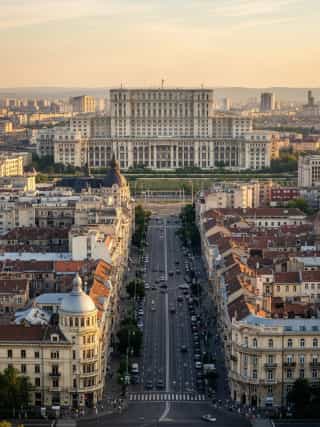
Bucharest - The Capital of Romania
- Population
- 1,883,425
- Language
- Romanian
- Continent
- Europe
- Since
- 1862
- Eco Ranking
- 34/195
Source: Environmental Performance Index 2024.
About Bucharest
Bucharest became the capital of the unified Romanian principalities in 1862, when Wallachia and Moldavia merged to form the United Principalities of Romania under Alexandru Ioan Cuza. The city had been the capital of Wallachia since the late 17th century. In the 20th century, Bucharest was shaped by two devastating periods: World War II, during which Romania allied with Nazi Germany and then switched to the Allied side in August 1944, and the communist dictatorship of Nicolae Ceaușescu (1965-1989). Ceaușescu's urban transformation project, known as Systematization, demolished an estimated 20% of historic Bucharest in the 1980s to construct the Civic Center, anchored by the Palace of the Parliament, a building of 365,000 square meters of floor space that is the second largest administrative building in the world by floor area, after the US Pentagon. Ceaușescu was overthrown and executed on 25 December 1989 in Romania's violent revolution, the only Eastern Bloc country where communist leaders were killed. The transition was centered in Bucharest. Today, Bucharest houses the Parliament, the Presidency, and the Constitutional Court. Romania joined NATO in 2004 and the EU in 2007.
About Romania
Romania is a semi-presidential republic in which executive power is shared between the President and the Prime Minister. It is a member of NATO and the EU, though it had not yet adopted the euro as of 2025. Romania experienced one of the most repressive communist regimes in Eastern Europe under Ceaușescu, and the legacy of that period continues to shape its institutions and political culture.
View Bucharest on the map
Flight time from Bucharest to other capitals
| City | Distance (km) | Flight Time |
|---|---|---|
| Rome | 1100 | 1h 18m |
| Paris | 1900 | 2h 14m |
| London | 2100 | 2h 28m |
| Abu Dhabi | 3400 | 4h 0m |
| Washington, D.C. | 8000 | 9h 25m |
| Cape Town | 8700 | 10h 14m |
| Tokyo | 8900 | 10h 28m |
| Singapore | 8900 | 10h 28m |
| Buenos Aires | 12200 | 14h 21m |
| Canberra | 15100 | 17h 46m |
Capitals with similar population to Bucharest
| City | Population |
|---|---|
| Minsk | 1,982,444 |
| Panama City | 1,938,000 |
| Vienna | 1,911,191 |
| Bucharest | 1,883,425 |
| Kuala Lumpur | 1,808,000 |
| Warsaw | 1,790,658 |
| Rabat | 1,777,000 |
Capitals with similar eco ranking to Bucharest
| City | Eco Rank |
|---|---|
| Budapest | 31 |
| Minsk | 32 |
| Wellington | 34 |
| Bucharest | 34 |
| Washington, D.C. | 35 |
| Paramaribo | 36 |
| Sofia | 37 |
Source: Environmental Performance Index 2024.
Frequently Asked Questions
When did Bucharest become the capital of Romania?
Bucharest became the capital of the United Principalities of Romania in 1862, when Wallachia and Moldavia merged. It had previously been the capital of Wallachia since the late 17th century. The city became the capital of the Kingdom of Romania in 1881 when independence was formally recognized and the principality became a kingdom.
What is the Palace of the Parliament in Bucharest?
The Palace of the Parliament is a massive government building constructed under Nicolae Ceaușescu's orders in the 1980s. With a floor area of approximately 365,000 square meters, it is the second-largest administrative building in the world by floor area, after the US Pentagon. Its construction required the demolition of large sections of historic Bucharest, including churches, synagogues, and residential neighborhoods.
What happened to Ceaușescu in Bucharest in 1989?
The Romanian Revolution began in December 1989 and rapidly moved to Bucharest, where Nicolae Ceaușescu attempted to address a crowd on 21 December but was met with hostile reactions. He fled the capital by helicopter but was captured, tried by a military tribunal, and executed along with his wife Elena on 25 December 1989. Romania was the only Eastern Bloc country where the communist leadership was violently overthrown and executed.
What was Ceaușescu's Systematization program?
Systematization was Ceaușescu's policy of demolishing and rebuilding urban areas according to communist planning principles. In Bucharest, this resulted in the destruction of an estimated 20% of the historic city center in the 1980s, including historic churches, monasteries, and residential districts, to make way for the Civic Center and wide ceremonial boulevards modeled partly on Pyongyang and Beijing.
Is Bucharest the largest city in Romania?
Yes. Bucharest is by far the largest city in Romania, with around 1.9 million people in the city and over 2.2 million in the metropolitan area. The second-largest city, Cluj-Napoca, has a population of around 320,000. Bucharest accounts for a disproportionate share of Romania's GDP and houses the country's main financial, media, and governmental institutions.
Sights and landmarks
Climate and best time to visit
Culture and customs
Economy