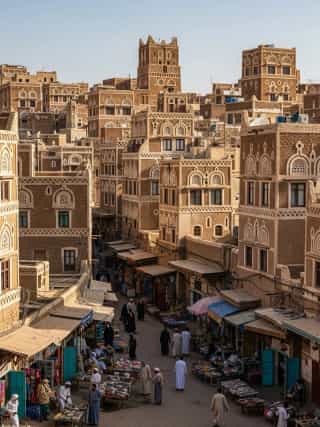
Sana'a - The Capital of Yemen
- Population
- 2,961,837
- Language
- Arabic
- Continent
- Asia
- Since
- 1962
- Eco Ranking
- -
Source: Environmental Performance Index 2024.
About Sana'a
One of the oldest continuously inhabited cities in the world, Sana'a became the capital of the Yemen Arab Republic (North Yemen) when the Imamate was overthrown by republican forces in 1962. Following the unification of North and South Yemen in 1990, Sana'a became capital of the unified Republic of Yemen. Sana'a is now a contested capital. Since the Houthi movement (Ansar Allah) seized the city in September 2014 and formally took control in January 2015, the internationally recognised Yemeni government has been unable to govern from Sana'a. It relocated first to Riyadh and then to Aden, which functions as the de facto seat of the recognised government. A Saudi Arabia-led military coalition intervened in March 2015 to support the recognised government. The conflict has produced one of the world's worst humanitarian crises, with millions facing famine and disease. Sana'a's medieval Old City, a UNESCO World Heritage Site since 1986, has suffered damage from airstrikes.
About Yemen
Yemen is a republic in a state of active civil conflict. The internationally recognised Presidential Leadership Council is based in Aden, while the Houthi movement controls Sana'a and much of northern Yemen. The conflict, ongoing since 2015, involves multiple armed factions and the intervention of a Saudi Arabia-led coalition. Yemen is classified as one of the world's most severe humanitarian emergencies.
View Sana'a on the map
Flight time from Sana'a to other capitals
| City | Distance (km) | Flight Time |
|---|---|---|
| Abu Dhabi | 1500 | 1h 46m |
| Rome | 4200 | 4h 56m |
| Paris | 5300 | 6h 14m |
| London | 5600 | 6h 35m |
| Cape Town | 6100 | 7h 11m |
| Singapore | 6700 | 7h 53m |
| Tokyo | 9500 | 11h 11m |
| Washington, D.C. | 11400 | 13h 25m |
| Buenos Aires | 12100 | 14h 14m |
| Canberra | 12300 | 14h 28m |
Capitals with similar population to Sana'a
| City | Population |
|---|---|
| Lisbon | 2,963,929 |
| Kyiv | 2,962,180 |
| Sana'a | 2,961,837 |
| Caracas | 2,935,744 |
| Guatemala City | 2,918,337 |
| Tashkent | 2,906,000 |
| Buenos Aires | 2,890,151 |
Frequently Asked Questions
Who controls Sana'a today?
Sana'a has been under the control of the Houthi movement (Ansar Allah) since September 2014. The Houthis are not internationally recognised as the legitimate government of Yemen. The internationally recognised Yemeni government operates from Aden, in the south of the country, which has functioned as the de facto capital since 2015.
When did Sana'a become the capital of Yemen?
Sana'a became the capital of North Yemen (the Yemen Arab Republic) when the republican revolution overthrew the Imamate in 1962. It became the capital of the unified Republic of Yemen in 1990 when North and South Yemen merged. South Yemen's former capital, Aden, became a secondary city in the unified state.
What is the humanitarian situation in Yemen?
Yemen has experienced one of the world's worst humanitarian crises since the escalation of conflict in 2015. The United Nations has repeatedly designated Yemen as having the largest humanitarian crisis globally, with millions of people facing food insecurity, disease outbreaks including cholera, and displacement. The destruction of infrastructure, including water, health, and sanitation systems, has compounded the crisis.
Is Sana'a's Old City at risk from the conflict?
Yes. Sana'a's Old City, inscribed as a UNESCO World Heritage Site in 1986 and known for its distinctive tower houses with white gypsum decoration, has been placed on UNESCO's List of World Heritage in Danger since 2015. Airstrikes and shelling have caused damage to historic buildings, and the conflict has severely disrupted conservation efforts.
Why did Yemen's civil war start?
Yemen's conflict grew from the political transition following the Arab Spring. President Ali Abdullah Saleh stepped down in 2012 under Gulf state pressure, but the subsequent government under Abd Rabbuh Mansur Hadi failed to stabilise the country. The Houthi movement, which had long fought against marginalisation of the Zaidi Shia community, exploited the political vacuum to expand territory, eventually seizing Sana'a in 2014.
Sights and landmarks
Climate and best time to visit
Regional significance
Economy