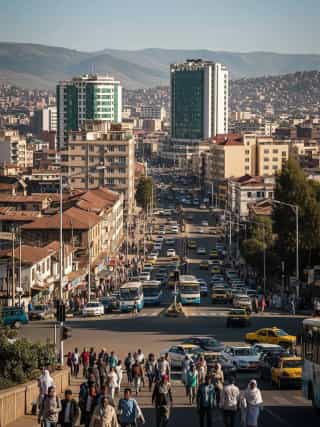
Addis Ababa - The Capital of Ethiopia
- Population
- 3,352,000
- Language
- Amharic
- Continent
- Africa
- Since
- 1886
- Eco Ranking
- 147/195
Source: Environmental Performance Index 2024.
About Addis Ababa
Addis Ababa was founded in 1886 by Emperor Menelik II of Ethiopia, who established it as his imperial seat after finding the climate of the highland site favorable. His consort, Empress Taytu Betul, named the city, the name means 'New Flower' in Amharic. The city became the capital of the Ethiopian Empire and, following the 1936-1941 Italian occupation, was restored as the seat of Haile Selassie's government. A Marxist military junta called the Derg seized power in 1974, deposing Selassie and ruling until 1991. After the fall of the Derg, the Ethiopian People's Revolutionary Democratic Front (EPRDF) established a federal government in Addis Ababa, which today houses the Parliament, the Federal Supreme Court, and the Office of the Prime Minister. The city holds exceptional geopolitical importance as the headquarters of the African Union since the organization's founding in 2002 (succeeding the Organisation of African Unity, also based here since 1963). Addis Ababa is the only African city that hosts a permanent seat of a continental intergovernmental organization.
About Ethiopia
Ethiopia is a federal parliamentary republic composed of ten regional states and two chartered cities, including Addis Ababa. The country operates under a 1995 constitution that grants regional states significant autonomy, including a theoretical right of secession. Ethiopia is the second most populous country in Africa and the only mainland African state never fully colonized by a European power. The African Union's continental headquarters are located in Addis Ababa, reinforcing the city's diplomatic significance beyond Ethiopia's borders.
View Addis Ababa on the map
Flight time from Addis Ababa to other capitals
| City | Distance (km) | Flight Time |
|---|---|---|
| Abu Dhabi | 2400 | 2h 49m |
| Rome | 4500 | 5h 18m |
| Cape Town | 5200 | 6h 7m |
| Paris | 5600 | 6h 35m |
| London | 5900 | 6h 56m |
| Singapore | 7200 | 8h 28m |
| Tokyo | 10400 | 12h 14m |
| Buenos Aires | 11200 | 13h 11m |
| Washington, D.C. | 11500 | 13h 32m |
| Canberra | 12400 | 14h 35m |
Capitals with similar population to Addis Ababa
| City | Population |
|---|---|
| Abuja | 3,464,000 |
| Addis Ababa | 3,352,000 |
| Santo Domingo | 3,339,410 |
| Pyongyang | 3,255,288 |
| Asunción | 3,222,000 |
| Athens | 3,090,508 |
| Antananarivo | 3,058,800 |
Capitals with similar eco ranking to Addis Ababa
Source: Environmental Performance Index 2024.
Frequently Asked Questions
When was Addis Ababa founded and by whom?
Addis Ababa was founded in 1886 by Emperor Menelik II of Ethiopia. He established his imperial court on the site after the area's highland climate proved favorable. The city's name, meaning 'New Flower' in Amharic, was given by Empress Taytu Betul.
Why is the African Union headquartered in Addis Ababa?
The Organisation of African Unity (OAU) was founded in Addis Ababa in 1963, largely due to Emperor Haile Selassie's diplomatic influence and Ethiopia's status as a symbol of African independence. When the OAU was replaced by the African Union in 2002, the headquarters remained in Addis Ababa.
Was Addis Ababa ever occupied by a foreign power?
Yes. Fascist Italy occupied Addis Ababa from 1936 to 1941 after the Second Italo-Ethiopian War. During the occupation, the Italians attempted to use it as the capital of Italian East Africa. Emperor Haile Selassie returned from exile and restored Ethiopian sovereignty in 1941 with Allied support.
Is Addis Ababa the largest city in Ethiopia?
Yes. Addis Ababa is by far the largest city in Ethiopia, home to an estimated 3.5 million people in the city proper and significantly more in the metropolitan area. It functions as a chartered city with a status equivalent to a regional state under Ethiopia's federal structure.
What happened politically in Addis Ababa after Emperor Haile Selassie?
In 1974, the Derg, a Marxist military council, overthrew and eventually killed Haile Selassie, making Addis Ababa the capital of a socialist state. The Derg ruled until 1991, when it was ousted by the EPRDF coalition. A new federal constitution was adopted in 1995.
Sights and landmarks
Climate and best time to visit
Regional significance
Culture and customs