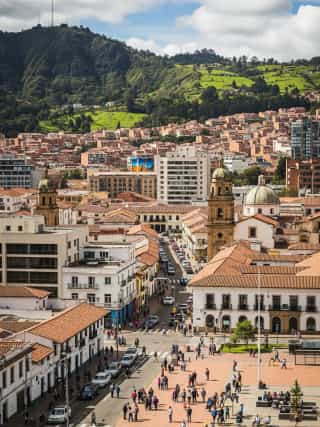
Bogotá - The Capital of Colombia
- Population
- 7,181,469
- Language
- Spanish
- Continent
- South America
- Since
- 1538
- Eco Ranking
- 67/195
Source: Environmental Performance Index 2024.
About Bogotá
Bogotá was founded by Spanish conquistador Gonzalo Jiménez de Quesada in 1538 on the high Andean plateau of the Eastern Cordillera, at an altitude of approximately 2,640 meters above sea level, making it one of the highest capital cities in the world. Under Spanish colonial rule, it served as the capital of the Viceroyalty of New Granada, which encompassed present-day Colombia, Venezuela, Ecuador, and Panama. After independence from Spain in 1819, it became the capital of Gran Colombia, the short-lived republic envisioned by Simón Bolívar, and then of the Republic of New Granada, and eventually of Colombia as it is known today. The city's political history has been marked by intense internal conflict: the assassination of populist leader Jorge Eliécer Gaitán in Bogotá on 9 April 1948 triggered the Bogotazo, a wave of urban violence that killed thousands and contributed to the broader period known as La Violencia. Bogotá houses the Congress of the Republic, the Supreme Court, and the Presidential Palace (Casa de Nariño). It is the seat of both the national government and the Cundinamarca department, though it functions as a separate Capital District. Colombia's 1991 constitution, drafted after decades of civil conflict, was a landmark attempt to rebuild democratic legitimacy.
About Colombia
Colombia is a presidential republic with a bicameral congress. The country emerged from a decades-long internal armed conflict involving guerrilla groups (FARC, ELN), paramilitary organizations, and drug trafficking networks. A 2016 peace agreement between the government and the FARC demobilized that group, though breakaway factions persist. Colombia is the world's largest producer of cocaine, a fact that has shaped its politics, institutions, and international relations throughout the late 20th and early 21st centuries.
View Bogotá on the map
Flight time from Bogotá to other capitals
| City | Distance (km) | Flight Time |
|---|---|---|
| Washington, D.C. | 3800 | 4h 28m |
| Buenos Aires | 4700 | 5h 32m |
| London | 8500 | 10h 0m |
| Paris | 8600 | 10h 7m |
| Rome | 9400 | 11h 4m |
| Cape Town | 10500 | 12h 21m |
| Abu Dhabi | 13600 | 16h 0m |
| Tokyo | 14300 | 16h 49m |
| Canberra | 14400 | 16h 56m |
| Singapore | 19300 | 22h 42m |
Capitals with similar population to Bogotá
Capitals with similar eco ranking to Bogotá
Source: Environmental Performance Index 2024.
Frequently Asked Questions
Why is Bogotá the capital of Colombia?
Bogotá became the capital because it was established as the administrative center of the Spanish Viceroyalty of New Granada in 1717, building on its founding as a colonial settlement in 1538. When Colombia gained independence, Bogotá's established role as the administrative and political hub of the region made it the natural choice as national capital.
How high is Bogotá?
Bogotá sits at approximately 2,640 meters (8,660 feet) above sea level on the Bogotá savanna in the Eastern Andes. This makes it one of the highest capital cities in the world, alongside Quito, Addis Ababa, and Nairobi, and significantly higher than most South American capitals.
What was the Bogotazo?
The Bogotazo refers to the urban uprising and riots that erupted in Bogotá on 9 April 1948 following the assassination of liberal populist leader Jorge Eliécer Gaitán. The violence killed thousands, destroyed much of the city center, and marked the beginning of La Violencia, a decade-long period of widespread rural and urban conflict between Liberal and Conservative factions that killed an estimated 200,000 Colombians.
Was Bogotá the capital of Gran Colombia?
Yes. From 1819, Bogotá, then called Santa Fe de Bogotá, served as the capital of Gran Colombia, the republic created by Simón Bolívar that united present-day Colombia, Venezuela, Ecuador, and Panama. Gran Colombia dissolved in 1831, but Bogotá remained the capital of the successor state that eventually became the Republic of Colombia.
Is Bogotá the largest city in Colombia?
Yes. Bogotá is by far the largest city in Colombia, with around 7.2 million people in the city proper and over 11 million in the metropolitan area. Medellín is the second-largest city with around 2.5 million in its metro area. Bogotá accounts for approximately a quarter of Colombia's total GDP.
Sights and landmarks
Climate and best time to visit
Culture and customs
Economy