Pyongyang - The Capital of North Korea
- Population
- 3,255,288
- Language
- Korean
- Continent
- Asia
- Since
- 1948
- Eco Ranking
- -
Source: Environmental Performance Index 2024.
About Pyongyang
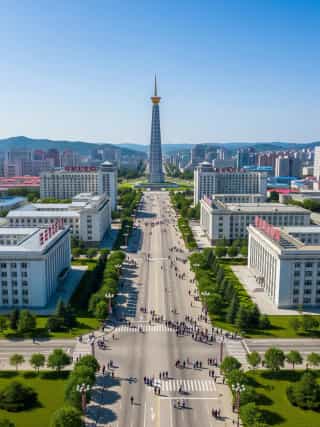
Pyongyang is one of the most tightly controlled capitals in the world. Residence in the city requires explicit government authorization, only politically reliable citizens and those with approved occupations are permitted to live there, making it a curated showcase of the North Korean state rather than a representative city. The Kim dynasty has ruled from Pyongyang since 1948: Kim Il-sung founded the Democratic People's Republic of Korea and governed until his death in 1994; Kim Jong-il succeeded him and ruled until 2011; Kim Jong-un has held power since. This three-generation dynastic succession is unprecedented among 20th-century communist states. The original city was virtually destroyed by US bombing during the Korean War (1950-1953), during which American forces applied sustained aerial bombardment to North Korean cities. Pyongyang was rebuilt from near-zero in the 1950s and 1960s in a monumental socialist architectural style, with wide boulevards, massive public squares, and propaganda monuments. The city is home to the Rungrado 1st of May Stadium, with a capacity of 114,000, the largest stadium in the world. North Korea has pursued nuclear weapons development since the 1990s and conducted six nuclear tests between 2006 and 2017. The country remains under extensive international sanctions and one of the most isolated states in the world.
About North Korea
North Korea is a single-party state governed by the Korean Workers' Party under the Kim family dynasty. Kim Jong-un holds the titles of General Secretary, Chairman of the State Affairs Commission, and Supreme Commander of the Armed Forces, concentrating all executive, legislative, and military authority. The country has pursued nuclear weapons and ballistic missile programs in direct confrontation with UN Security Council resolutions.
View Pyongyang on the map
Flight time from Pyongyang to other capitals
| City | Distance (km) | Flight Time |
|---|---|---|
| Tokyo | 1300 | 1h 32m |
| Singapore | 4700 | 5h 32m |
| Abu Dhabi | 6800 | 8h 0m |
| Canberra | 8600 | 10h 7m |
| London | 8700 | 10h 14m |
| Paris | 8800 | 10h 21m |
| Rome | 8800 | 10h 21m |
| Washington, D.C. | 11000 | 12h 56m |
| Cape Town | 13700 | 16h 7m |
| Buenos Aires | 19400 | 22h 49m |
Capitals with similar population to Pyongyang
| City | Population |
|---|---|
| Addis Ababa | 3,352,000 |
| Santo Domingo | 3,339,410 |
| Pyongyang | 3,255,288 |
| Asunción | 3,222,000 |
| Athens | 3,090,508 |
| Antananarivo | 3,058,800 |
| Brasília | 3,055,149 |
Frequently Asked Questions
Who controls North Korea and Pyongyang?
North Korea is governed by Kim Jong-un, the third leader from the Kim family dynasty. Kim Il-sung ruled from 1948 to 1994, Kim Jong-il from 1994 to 2011, and Kim Jong-un has ruled since 2011. Power is exercised through the Korean Workers' Party, which controls all state institutions, media, and military.
Why is access to Pyongyang restricted?
The North Korean government strictly controls who may live in Pyongyang. Residency requires government authorization and is generally granted to families with strong loyalty records and approved professional backgrounds. The city is designed in part as a propaganda showcase and its residents receive better food allocations, housing, and services than most North Koreans.
Was Pyongyang destroyed during the Korean War?
Yes. US and UN forces subjected Pyongyang to extensive aerial bombardment during the Korean War (1950-1953), destroying most of the city's pre-war structures. The city was rebuilt from near-zero in the postwar decades in a monumental Soviet-influenced architectural style, which is why virtually no pre-war buildings remain.
When did North Korea become a separate state?
North Korea was formally established as the Democratic People's Republic of Korea on September 9, 1948, under Kim Il-sung, with Soviet backing. The Korean peninsula had been divided along the 38th parallel after Japan's defeat in 1945, with the Soviet Union administering the north and the United States the south. The Korean War (1950-1953) ended in an armistice, not a peace treaty, leaving the peninsula technically still at war.
What is the Rungrado 1st of May Stadium?
The Rungrado 1st of May Stadium in Pyongyang is the world's largest stadium by seating capacity, holding approximately 114,000 spectators. It is used for football matches and the mass choreographed performances known as the Arirang or Mass Games, which are a major instrument of state propaganda and public political spectacle.
Sights and landmarks
Climate and best time to visit
Regional significance
Economy