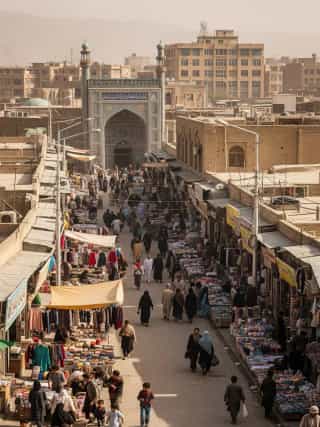
Kabul - The Capital of Afghanistan
- Population
- 4,601,789
- Language
- Pashto
- Continent
- Asia
- Since
- 999
- Eco Ranking
- 171/195
Source: Environmental Performance Index 2024.
About Kabul
Kabul has functioned as Afghanistan's capital since the late 18th century when the Durrani Empire established it as its seat of government, though the city's history as a significant urban center extends at least to the 10th century. Situated in a valley at approximately 1,800 meters elevation, Kabul's strategic position has made it a persistent focal point of regional and imperial competition. Britain fought three wars with Afghanistan in the 19th and early 20th centuries largely over control of approaches through Kabul. The Soviet Union invaded Afghanistan in 1979 and installed a communist government in Kabul; the subsequent decade-long war resulted in over a million deaths and the eventual Soviet withdrawal in 1989. After years of civil war, the Taliban first captured Kabul in 1996, governing Afghanistan until the US-led invasion following the September 11 attacks in 2001. Twenty years of international military presence and a US-backed government ended abruptly when the Taliban took Kabul on August 15, 2021, as US and NATO forces completed their withdrawal. The US-backed government collapsed without significant resistance. The Taliban now govern Afghanistan from Kabul under their interpretation of Islamic law; the country has no internationally recognized government. Kabul's population grew dramatically, roughly tripling between 2001 and 2021, as millions fled rural conflict, creating an enormous urban concentration. No country in the world has formally recognized the Taliban government.
About Afghanistan
Afghanistan is governed by the Taliban, who have controlled the country since August 2021. No country officially recognizes the Taliban administration as Afghanistan's legitimate government. The Taliban have prohibited girls from secondary and higher education, banned women from most employment and public spaces, and restricted a wide range of civil and political freedoms. Afghanistan is heavily dependent on international humanitarian aid, much of which has been curtailed since the Taliban takeover. The country faces severe economic contraction and a humanitarian crisis.
View Kabul on the map
Flight time from Kabul to other capitals
| City | Distance (km) | Flight Time |
|---|---|---|
| Paris | 5200 | 6h 7m |
| London | 5500 | 6h 28m |
| Abu Dhabi | 5500 | 6h 28m |
| Singapore | 6000 | 7h 4m |
| Cape Town | 8500 | 10h 0m |
| Washington, D.C. | 9700 | 11h 25m |
| Tokyo | 9700 | 11h 25m |
| Rome | 9700 | 11h 25m |
| Canberra | 12000 | 14h 7m |
| Buenos Aires | 12000 | 14h 7m |
Capitals with similar population to Kabul
Capitals with similar eco ranking to Kabul
| City | Eco Rank |
|---|---|
| Djibouti | 168 |
| Manila | 169 |
| Phnom Penh | 170 |
| Kabul | 171 |
| Baghdad | 172 |
| Antananarivo | 173 |
| Asmara | 174 |
Source: Environmental Performance Index 2024.
Frequently Asked Questions
When did the Taliban take control of Kabul?
The Taliban entered Kabul on August 15, 2021, as the US-backed Afghan government collapsed following the withdrawal of US and NATO forces. President Ashraf Ghani fled the country, and the Taliban assumed control of the presidential palace within hours.
How long has Kabul been the capital of Afghanistan?
Kabul has served as Afghanistan's capital since the late 18th century, when Ahmad Shah Durrani's successors established it as the center of the Durrani Empire. The city has been historically significant for much longer, with evidence of settlement and urban importance dating back over a thousand years.
Is Afghanistan's Taliban government internationally recognized?
No country has formally recognized the Taliban administration as the legitimate government of Afghanistan. Several countries, including Pakistan and China, have maintained diplomatic engagement, but formal recognition has not been extended by any UN member state.
Why did Kabul's population grow so rapidly between 2001 and 2021?
Kabul's population roughly tripled between 2001 and 2021 as millions of Afghans fled rural areas affected by Taliban insurgency, US and NATO military operations, and general insecurity. The city offered relative safety and access to international aid, employment, and services unavailable in rural provinces.
What role did Kabul play in the Soviet-Afghan War?
Kabul was the seat of the Soviet-backed communist government of Afghanistan from 1979 to 1992. The Soviet Union installed its client government there and used the city as the command center for its military operations. Kabul was subsequently the scene of severe fighting during the civil war that followed Soviet withdrawal, including extensive destruction from factional rocket attacks in the early 1990s.
Sights and landmarks
Climate and best time to visit
Regional significance