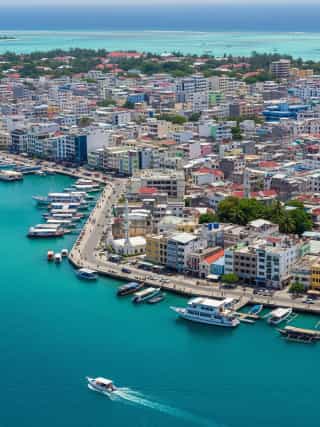
Malé - The Capital of Maldives
- Population
- 227,486
- Language
- Dhivehi
- Continent
- Asia
- Since
- 1965
- Eco Ranking
- 137/195
Source: Environmental Performance Index 2024.
About Malé
Malé has been the seat of Maldivian governance for centuries, serving as the royal capital of the Maldives Sultanate before the country became a British protectorate in 1887. The Maldives gained full independence on 26 July 1965, and Malé became the capital of the republic established when the sultanate was formally abolished in 1968. Malé is among the most densely populated cities in the world, with approximately 230,000 people compressed onto an island of roughly six square kilometers. The city has expanded through extensive land reclamation projects, and a second artificial island, Hulhumalé, has been developed adjacent to Malé to absorb population growth. The Maldives is one of the countries most existentially threatened by sea-level rise: the archipelago's average ground elevation is under one meter above sea level. Former president Mohamed Nasheed, the Maldives' first democratically elected president, in 2008, became an internationally prominent climate advocate, holding an underwater cabinet meeting in 2009 to highlight the threat. Nasheed was ousted in 2012 under disputed circumstances and later sentenced to 13 years in prison on terrorism charges widely criticized as politically motivated. Malé is the seat of the People's Majlis (parliament), the presidency, and all central government institutions. The Maldives only converted from a sultanate to a republic in 1968.
About Maldives
The Maldives is an island nation in the Indian Ocean, comprising approximately 1,200 coral islands grouped in 26 atolls. It was a British protectorate from 1887 until independence in 1965. The sultanate was abolished by referendum in 1968. The country held its first multiparty democratic elections in 2008, won by Mohamed Nasheed. Since then it has experienced political instability, including a disputed transfer of power in 2012. The Maldives is one of the world's lowest-lying countries and a leading voice in international climate negotiations.
View Malé on the map
Flight time from Malé to other capitals
| City | Distance (km) | Flight Time |
|---|---|---|
| Abu Dhabi | 3000 | 3h 32m |
| Singapore | 3400 | 4h 0m |
| Cape Town | 7200 | 8h 28m |
| Rome | 7300 | 8h 35m |
| Tokyo | 7600 | 8h 56m |
| Paris | 8300 | 9h 46m |
| London | 8500 | 10h 0m |
| Canberra | 9000 | 10h 35m |
| Buenos Aires | 14000 | 16h 28m |
| Washington, D.C. | 14400 | 16h 56m |
Capitals with similar population to Malé
| City | Population |
|---|---|
| Nassau | 274,400 |
| Porto-Novo | 264,320 |
| Gaborone | 246,325 |
| Paramaribo | 240,924 |
| Malé | 227,486 |
| Wellington | 215,800 |
| Podgorica | 187,085 |
Capitals with similar eco ranking to Malé
Source: Environmental Performance Index 2024.
Frequently Asked Questions
When did Malé become the capital of the Maldives?
Malé has functioned as the seat of Maldivian governance for several centuries as the royal capital of the Sultanate. It formally became the capital of the independent Republic of Maldives on 11 November 1968, when the country abolished the sultanate by referendum. Full independence from Britain had been achieved on 26 July 1965.
How dense is the population of Malé?
Malé is one of the most densely populated cities in the world. Approximately 230,000 people live on an island of roughly 6 square kilometers, yielding a population density of around 38,000 people per square kilometer. This is comparable to or exceeding the densest urban areas in cities like Manila or Dhaka.
Why is the Maldives so vulnerable to sea-level rise?
The Maldives consists of coral atolls with an average ground elevation of under one meter above sea level, the lowest average elevation of any country in the world. Even modest sea-level rise combined with storm surges poses a severe threat to the freshwater lens, agricultural land, and inhabited areas. The government has explored purchasing land in other countries as a potential relocation option.
Who was Mohamed Nasheed and why was he significant?
Mohamed Nasheed was the Maldives' first democratically elected president, winning the 2008 election. He became internationally known for staging an underwater cabinet meeting to highlight sea-level rise threats and for advocating ambitious carbon reduction targets at international climate negotiations. He was ousted in February 2012 under circumstances he and international observers described as a coup, and was subsequently convicted on terrorism charges in 2015, a verdict criticized by the UN Human Rights Committee.
Is Malé the largest city in the Maldives?
Yes, Malé is overwhelmingly the largest city in the Maldives. The greater Malé region, including the adjacent reclaimed island of Hulhumalé and Vilimalé, houses more than half the country's total population of approximately 520,000. Most of the remaining population is dispersed across inhabited atolls, many with very small communities.
Sights and landmarks
Climate and best time to visit
Economy