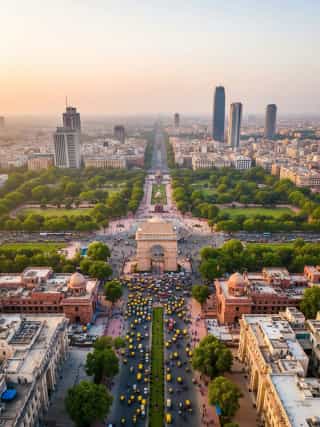
New Delhi - The Capital of India
- Population
- 32,226,000
- Language
- Hindi
- Continent
- Asia
- Since
- 1911
- Eco Ranking
- 176/195
Source: Environmental Performance Index 2024.
About New Delhi
New Delhi was conceived as a new imperial capital by the British colonial administration, which decided in 1911 to move the seat of government from Calcutta (Kolkata) to Delhi. British architects Edwin Lutyens and Herbert Baker designed the planned city, which was formally inaugurated in 1931. The move was intended to signal British permanence in India, in practice, India achieved independence just 16 years later, in 1947. New Delhi is technically a district within the larger Delhi metropolitan area, specifically the planned government zone, rather than the entire city. The National Capital Territory of Delhi, encompassing New Delhi and surrounding areas, is the world's most populous capital city region, with over 32 million people. New Delhi houses the three branches of the Indian federal government: the President's Estate (Rashtrapati Bhavan), Parliament House, and the Supreme Court, all arranged along the ceremonial axis of Rajpath (now Kartavya Path). India's partition in 1947 brought massive population displacement through Delhi, with Muslim residents leaving for Pakistan and Hindu and Sikh refugees arriving from Pakistani Punjab. India is the world's most populous democracy, and New Delhi is the seat of a federal government governing 1.4 billion people.
About India
India is a federal parliamentary republic with 28 states and 8 Union Territories. New Delhi is itself a Union Territory, the National Capital Territory of Delhi, with a partially elected government and a Lieutenant Governor appointed by the central government, creating ongoing jurisdictional tensions between state and central authority. The President is head of state, but executive power rests with the Prime Minister and cabinet. India has held uninterrupted multiparty elections since independence in 1947. The Bharatiya Janata Party (BJP) under Narendra Modi has governed at the federal level since 2014.
View New Delhi on the map
Flight time from New Delhi to other capitals
| City | Distance (km) | Flight Time |
|---|---|---|
| Abu Dhabi | 2300 | 2h 42m |
| Singapore | 4100 | 4h 49m |
| Tokyo | 5800 | 6h 49m |
| Rome | 5900 | 6h 56m |
| Paris | 6600 | 7h 46m |
| London | 6700 | 7h 53m |
| Cape Town | 9300 | 10h 56m |
| Canberra | 10400 | 12h 14m |
| Washington, D.C. | 12000 | 14h 7m |
| Buenos Aires | 15800 | 18h 35m |
Capitals with similar population to New Delhi
Capitals with similar eco ranking to New Delhi
Source: Environmental Performance Index 2024.
Frequently Asked Questions
Why did the British move India's capital from Calcutta to Delhi?
The British announced the move in 1911 at the Delhi Durbar, a royal assembly marking the coronation of King George V. The decision was driven by a desire to move the capital to a more central location, to distance government from the politically active Bengali population of Calcutta, and to assert British permanence by building an entirely new capital city. New Delhi was formally inaugurated in 1931.
What is the difference between Delhi and New Delhi?
Delhi refers to the National Capital Territory, a large urban agglomeration of over 32 million people. New Delhi is a district within that territory, specifically the planned colonial-era government zone designed by Lutyens and Baker. The Government of India uses 'New Delhi' as the official name of the capital, but 'Delhi' is commonly used to refer to the broader city.
When did New Delhi become the capital of India?
New Delhi was formally inaugurated as the capital of British India on February 13, 1931. When India gained independence on August 15, 1947, New Delhi continued as the capital of the newly independent republic.
Is New Delhi the largest city in India?
The Delhi metropolitan area, encompassing New Delhi and surrounding zones, is the largest urban agglomeration in India and the most populous capital city region in the world, with over 32 million people. Mumbai is the largest city in India by city-proper definition in some measures, but Delhi's overall metropolitan area is larger.
What is the political status of the Delhi territory?
Delhi is a Union Territory with special status, the National Capital Territory of Delhi. It has an elected Legislative Assembly and a Chief Minister, but also a Lieutenant Governor appointed by the central government who holds significant powers. This dual authority has led to repeated political conflicts, particularly between the Aam Aadmi Party (AAP) governments and the central government over administrative control.
Sights and landmarks
Climate and best time to visit
Culture and customs