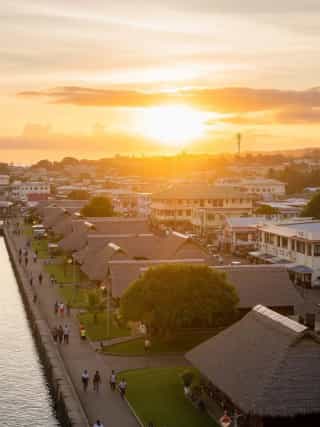
Apia - The Capital of Samoa
- Population
- 36,735
- Language
- Samoan
- Continent
- Oceania
- Since
- 1959
- Eco Ranking
- 82/195
Source: Environmental Performance Index 2024.
About Apia
Apia is the capital of the Independent State of Samoa, occupying a bay-side position on the north coast of Upolu island. The city emerged as a commercial and administrative center during the 19th century, when Samoa was subject to competing imperial interests from Germany, Britain, and the United States. The 1899 Tripartite Convention divided the Samoan archipelago between Germany (Western Samoa, including Upolu and Apia) and the United States (American Samoa), with Britain withdrawing its claims in exchange for concessions elsewhere. Apia served as the capital of German Samoa until 1914, when New Zealand forces occupied the territory at the outbreak of World War I. New Zealand administered the territory under a League of Nations mandate and subsequently a UN Trusteeship until Western Samoa became independent on 1 January 1962, the first Pacific Island nation to gain independence in the 20th century. Apia became the capital of the independent state, hosting the parliament (Fono) and the head of state's office. The country's name was officially changed from Western Samoa to Samoa in 1997, a change that caused a prolonged diplomatic dispute with neighboring American Samoa and the United States.
About Samoa
Samoa is a parliamentary republic with a largely ceremonial head of state (O le Ao o le Malo), historically chosen from among the country's four paramount chiefs. The Prime Minister holds executive authority. Samoa was the first Pacific Island nation to gain independence in the 20th century, doing so in 1962. The country operates under a constitution that blends Westminster parliamentary traditions with elements of traditional Samoan governance (fa'amatai). Samoa shares the Samoan archipelago with the US territory of American Samoa.
View Apia on the map
Flight time from Apia to other capitals
| City | Distance (km) | Flight Time |
|---|---|---|
| Canberra | 4600 | 5h 25m |
| Tokyo | 7500 | 8h 49m |
| Singapore | 9400 | 11h 4m |
| Buenos Aires | 11200 | 13h 11m |
| Washington, D.C. | 11400 | 13h 25m |
| Cape Town | 14600 | 17h 11m |
| Abu Dhabi | 15000 | 17h 39m |
| London | 15800 | 18h 35m |
| Paris | 16100 | 18h 56m |
| Rome | 16900 | 19h 53m |
Capitals with similar population to Apia
| City | Population |
|---|---|
| Monaco | 39,244 |
| Port of Spain | 37,074 |
| Apia | 36,735 |
| Banjul | 31,301 |
| Majuro | 28,000 |
| Victoria | 26,450 |
| Nuku'alofa | 23,658 |
Capitals with similar eco ranking to Apia
| City | Eco Rank |
|---|---|
| Amman | 79 |
| Port Louis | 79 |
| Buenos Aires | 81 |
| Apia | 82 |
| Doha | 83 |
| Lusaka | 84 |
| Moscow | 84 |
Source: Environmental Performance Index 2024.
Frequently Asked Questions
When did Apia become the capital of independent Samoa?
Apia became the capital of independent Western Samoa on 1 January 1962, when the country gained independence from New Zealand administration. This made Samoa the first Pacific Island nation to achieve independence in the 20th century. Apia had previously served as the capital of German Samoa and of the New Zealand-administered territory.
Was Samoa ever divided between colonial powers?
Yes. The 1899 Tripartite Convention between Germany, the United States, and Britain divided the Samoan archipelago. Germany received the western islands (including Upolu and Apia), while the United States took the eastern islands (now American Samoa). Britain withdrew its Samoan claims in exchange for other territorial concessions.
Is Apia the largest city in Samoa?
Yes. Apia is the only urban center of significant size in Samoa. The greater Apia area holds the majority of the country's roughly 200,000 inhabitants. The country is predominantly rural, with most of the population living in villages governed by traditional chiefly structures.
What is the political system of Samoa?
Samoa is a parliamentary republic whose constitution blends Westminster conventions with traditional Samoan governance. The head of state is elected by Parliament from among the country's paramount chiefs. The Prime Minister leads the government. Universal suffrage was not granted until 1990; previously only matai (chiefs) could vote.
Why did Samoa change its name from Western Samoa?
Samoa changed its official name from Western Samoa to Samoa in 1997 to assert that it represents the Samoan people as a whole, not merely one half of a geographic division. The change was disputed by American Samoa and the United States, which argued it implied territorial claims. The name change was recognized internationally and acknowledged by the United Nations.
Sights and landmarks
Climate and best time to visit
Culture and customs
Economy